
Introduction
In the 1970s and 80s, names like Bieraš Ovllá, Buljohk Áne and Bikkul Ánte were common in Olmmáivággi (Manndalen) even though the conversations took place in Norwegian. The names were a natural part of daily life and culture. If you look elsewhere, you'll find that this is an oral naming tradition that is common in Sami areas. The tradition is to use one or more name links in front of the first name. The most common was to put a parent's name before the first name when referring to a person. I can use my grandmother as an example. She was always called Málu Siinná. Málu was the mother of Siinná. Another fairly common variant was to put a place name in front of the personal name (tables of Sami names and names in Norwegian can be found under «Additional information» at the bottom of the article).
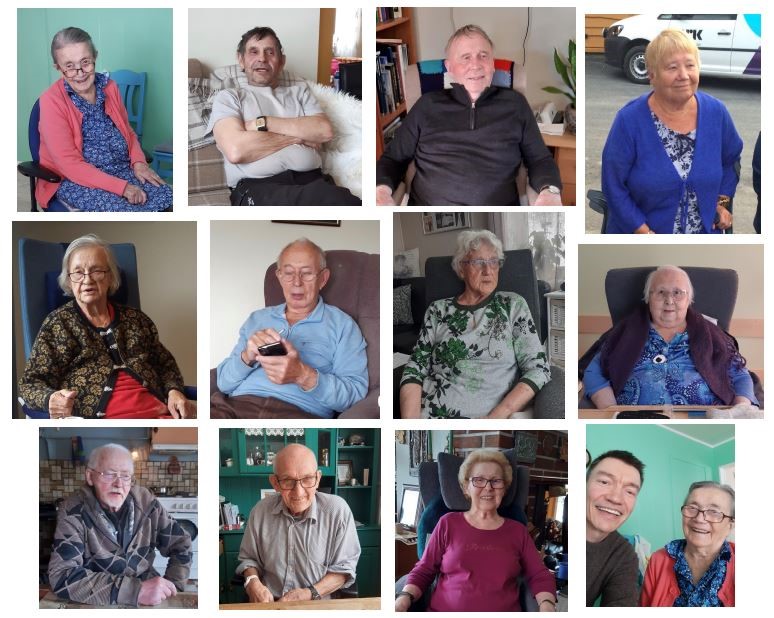
Although the tradition has been used over large geographical areas, there has been little research or documentation of the tradition. In this project, I wanted to document the use of the Sami name tradition around the Lyngenfjord. The project has been about collecting names and finding information about the background to the names.
According to Rasmussen (2012), most of the original North Sami names went out of written use in the 15th and 16th centuries. At the same time, she points out that there has been a parallel oral naming tradition since the 17th century. "In the few articles I have come across on this topic, it is said that it was most common for the father's name to be used before the proper name. Some exceptions are mentioned, such as that the mother's name is always used when the child is born out of wedlock, even if the father is known (Solem 1933:56).
Number and examples of names
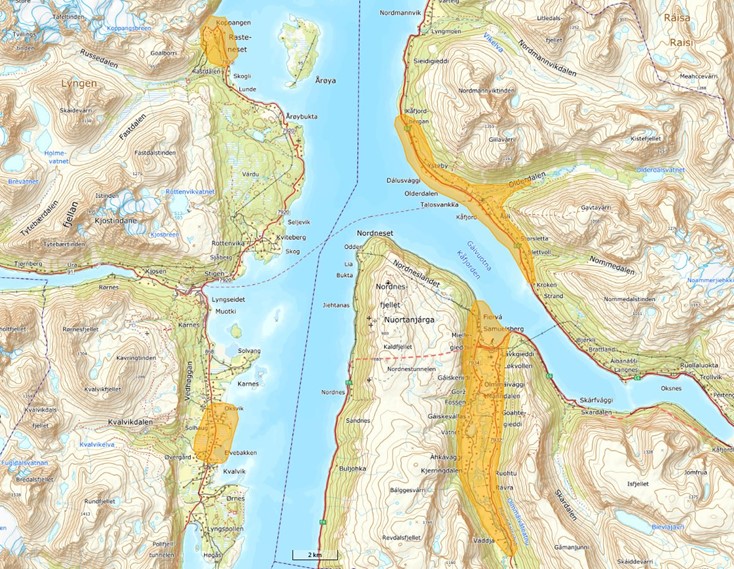
In total, I documented 356 people with traditional Sámi names, i.e. names that had at least two parts. There were 280 in Olmmáivággi, 68 in Dálusvággi (Olderdalen) and eight in Lyngen. In addition to names from parents and places, some people also received names from spouses, relatives and others. Of the 280 documented names in Olmmáivággi, 129 are women's names and 152 are men's names.
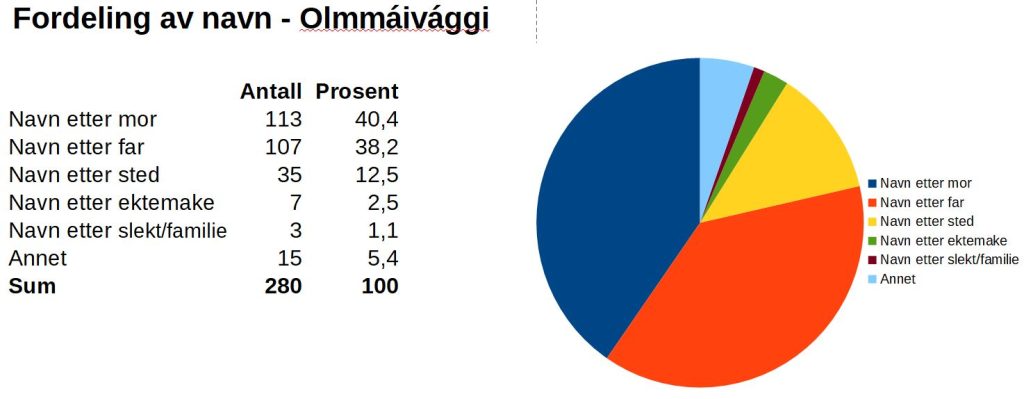
In Olmmáivággi, we see that parents are by far the largest group of first links in the name. As many as 78.7 % of the people have been named after their parents. 114 people had the first part of their name named after their mother and 107 had the first part named after their father. Thirty-five people had a place name as the first part of their name. It seems that it was common for people on the outskirts of the village to be mentioned with a place name. Examples are Váddj Ántun and Skuole Hánsa. Another type of name is from places outside the village. People who moved in sometimes brought the place name with them from their hometown. Examples are Gáivuon Biera, Buljohk Áne and Ittarvuon Juhán (The place names can be searched for on norgeskart.no).
There were seven people in Olmmáivággi who had the name of their husbands in the first degree. For two of the people, both the former name and the new name are documented. Jánna from Vatnet was first named Ján Iŋggá Jánná. She married Migá who lived at Steinmoen. After that, she became Migá Jánná. Čor Iŋggá Peder lived in Áhkavággi (Kjerringdalen) when he was young. His mother Iŋgá was from Čorru, a ridge in Áhkavággi. He then married Bikke Johánná in Hánnosiida. Johanna was the daughter of Bigge. Peder moved to his home town of Johánná and after that he became Bikke Peder. I have not found any information about why the village gave these people new names when they married.
There were 15 names in the group called “other” in Olmmáivággi. The names here have different origins. Some people got their name from the home they lived in. One example is Mártá, daughter of Biehtár Ovllá. Ovllá settled in Gáiskeriidi. According to the family, there was a roadworks barrack on the property when Ovllá bought it. Ovllá put turf on the barrack to insulate it and used it as a dwelling. The building became known as Bráhka, Mártá grew up in it and was therefore called Bráhke Mártá.
Another custom worth mentioning is that the only daughter or son in a family was often called Bárdni (boy) and Nieida (girl). An example is Girst Iŋggá Nieidá. Her grandmother was called Girste and her mother Iŋggá. The girl herself was called Marie in Norwegian. Another example is Ánton, who after the Second World War was referred to as Sjåbakken in Norwegian. In Sami he was called Mihk Áne Bártni. He was the only son of Áne, who in turn was the daughter of Migu.
Dálusvággi (Olderdalen)
Of the 68 documented names in Dálusvággi, 22 are women's names and 46 are men's names. 13 people have the first part of their name from their mother and 29 people have the first part from their father. As we can see, the proportion of people with the first part of their name from their mother is less than half of those with names from their father.
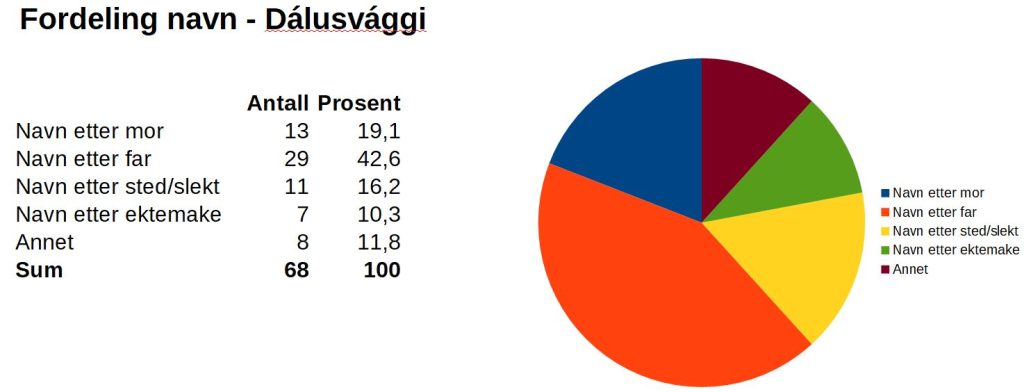
There were 11 people who had a place name as the first part of their name. As many as seven of the eleven had Čoru as the first part of their name and were from the same family. The brothers Čor Erik and Čoru Henrik are the oldest in this group. Čoru is not found on maps, but it is a ridge located about 800 metres inside (south of) the Olderdalselva river. There were seven people in Dálusvággi, who were named after their husbands in the first line. All seven were women, i.e. the wife had been given her husband's name.
There were eight people in the group labelled “other”. Three of the names come from names with unknown meanings, including the brothers Čorka Per and Čork Ola. Čork Ola was later named Flounder Ola, at least in Norwegian. He got the new name because he was a very active flounder fisherman.
Lyngen - Ivgu
In Lyngen, I was only able to document eight names. From Mellomjord I got the following names Pettu Aksel and Rinde Petter. Pettu Aksel was adopted and the name Pettu originally came from Storfjord. The origin of the name Rinde is unknown. In Gohppi (Koppangen) I was able to document the names Anton Jenssa Jenny and Skáidi Málu. Jenny got her first name from the man she was married to. Skáidi Málu got her name from the place she lived in Skáidi is not on the map, but was in the centre of Gohppi.
An informant in Gohppi was born in 1932. She didn't speak Sami herself, but her parents had spoken Sami when they didn't want their children to understand. This suggests that Norwegianisation began earlier in Lyngen than in Kåfjord, where children learned Sami in the 1930s. As a result of the death of the Sami language, the name tradition also disappeared earlier. The few names that are still remembered seem to have changed to the Norwegian language form.
I should add that I haven't investigated the Vuosvággi (Furuflaten) area in the project. The language situation there is more similar to that in Kåfjord and there is a good chance of finding more traditional names there.
Different names among siblings
In some cases, some children received the first part of their name from their mother and others in the same sibling group received the first part from their father. Gilvvagiet Májjen and Moart Ierkke lived at Gilvatgieddi (Steinlien) in Olmmáivággi. They had five children together. The two oldest children in the siblings were named after their mother. They were Májjen Ovllá and Májjen Ánná. The three youngest, however, were named after their father. They were called Moart Ierkke Siinná, Moart Ierkke Ingvállá and Moart Ierkke Knuvtte.
The fact that the children were given different first joints together with the Májjen died of the Spanish flu in 1918. By this time, the two oldest children were adults and had probably established their names. The youngest were still children. Perhaps their name had not yet settled. Another factor was that the family moved from Májjen's home and closer to Moart Ierkke's home after she died. The name of the deceased Májjen was perhaps less natural as a first name than her father's name.
Name from mother or father - geographical differences
In Dálusvággi, we saw that the proportion of people with the first part of their mother's name was less than half of those with their father's name. The results from Olmmáivággi, on the other hand, showed that the mother's and father's names were more or less evenly distributed. In an unpublished memo, Qvigstad (c. 1950) writes that the mother's name in the first part was common in Olmmáivággi, Sørfjorden in Ullsfjord and perhaps in Kautokeino. Why do these places stand out? Initially, I thought that Olmmáivággi is/has been a place with a very high proportion of Sami population and a strong Sami culture. Even after decades of Norwegianisation, around 80 % of the population of Olmmáivággi spoke Sami as their everyday language around 1900 (Bjerkli and Thuen 1998). Indre Sørfjorden in Ullsfjord had a Sami population of around 90 % in 1900 (Larsen 2008:124).
But what about Storfjord? Storfjord had a high proportion of Sami population in the 1800s, but in the 1930 census the proportion counted as Sami was 26 %. The number with Sami as their everyday language was only 16 %. If you compare this with the whole of Kåfjord, the number counted as Sami there was 50 % and the number with Sami as a daily language was 45 % (SST 1930). When you also realise that it was in the inner parts of Kåfjord, Olmmáivággi, Skárfvággi and Gáivuonvággi that the proportion of Sami was highest, you can see that Olmmáivággi differs greatly from Storfjord in 1930.
If we look back to Dálusvággi, I believe that the development I have outlined for Storfjord also fits in there. A quick review of the 1900 census for the stretch from Numedalen to Gáivuonorrid (Kåfjordbergan) showed that out of 46 households, one or both of the main characters were Finnish/Kven in 17 of them. In Olmmáivággi, I found two households in the 1900 census where one of the main persons had Finnish/Kven ethnicity.
To summarise, I imagine that in places where the Sámi language is strong, the traditional Sámi name tradition is also strong. In this tradition, the mother's name could just as easily be used as the first link as the father's name. This probably also says something about the fact that women's position has traditionally been stronger. On the other hand, I imagine that in places with stronger Norwegianisation and a smaller proportion of the Sami population, the Norwegian naming tradition has more impact. In the Norwegian context, the name is consistently passed through the paternal line. I assume that this may have had an impact on the Sami tradition as well.
What about Kven names?
Imerslund (e.g. 2010) has written about the Kven name tradition in Nordreisa. The tradition she describes is quite similar to the one I describe in the Lyngen area. This raises the question of whether some of the names I have collected could be Kven? However, Kven names in Nordreisa have Kven/Finnish words in them and also have special Finnish endings (-i, -in, -en). I have not found any such names in Kåfjord.
Ancient pre-Christian names?
Many of the names used in the Sami naming tradition can be recognised from a Norwegian perspective based on their similarity to Scandinavian/Christian names. Examples of such names are Biret, Inga, Jovnna and Niilás. But I think there are also names that don't have such clear parallels to Scandinavian names. Examples of this are Nigu, Begas, Billá and Málu. My theory is that some of these may be old pre-Christian Sami names that have only survived in oral tradition. One of the names that sounds old to me is Bikkul. Bikkul lived in Áhkavággi and is listed with the name Berit Eriksen in the census records. Bikkul does not look much like the Norwegian name Berit.
Some names used in Norwegian have a wide variety of Sami parallels. The name that in Norwegian was Berit, could in Sami be Biret, Binná, Billá, Bio, Bigge and Bikkul. Peder in Norwegian could be called Peder in Sami Biera, Bieraš, Biere, Bierran, Piersa, Pierso, Biehtár, Pede, Begas, Begaš, Pelle, Petta, Pette, Petto and Biede. I think it's quite possible that several of these have been around for centuries and are original Sami first names.
An oral tradition
The documentation shows a widespread tradition in the Lyngen area of favouring parental names over personal names. Almost all people had such names and the names were known and used by everyone. At the same time, everyone had an “official” Norwegian name. The Norwegian name was used in baptisms, marriages and in public documents. However, Norwegian written culture had little to do with everyday life. Many people, at least until the Second World War, did not recognise the culture or the names used by public authorities.
A fairly well-known story from Olmmáivággi can serve as an example. Someone from the authorities came to Olmmáivággi and wanted to find Peder Øverli. He tried to ask a man in the neighbourhood if he knew where Peder Øverli lived. The man replied: “No, I don't know. Ask Bikke Peder, he comes there”. Those in the know had realised that Peder Øverli was the official name of just Bikke Peder.
Another example of the culture clash is more serious and symbolic. My mum's uncle, Kristiinná Ovllá, For a long time there were graves in the cemetery in Olmmáivággi. It was common for people to come and see the grave of a relative, but often they couldn't find it. The problem was that they only knew the Sami name of the relative, while the official Norwegian names were written on the gravestones. Ovllá was well known in both the village and the municipality and had learnt the official names. When he happened to be there, he could point them to the right grave.
Pre-normalisation and continuation
The tradition of Sami naming declined sharply after the Second World War. But those who had already been given a name kept it. The “old” names were used in Sami, but also in Norwegian when the majority of the population switched to speaking Norwegian. Roggi Jákob lived in Roggi in Dálusvággi. He became for many Gropa Jakob. Another example is Máret Ovllá from Áhkavággi. He eventually became Máret Ola and to Mart Ola in Norwegian. Some names have probably only existed in Norwegian. An example from Olmmáivággi is Ivar the ploughman who drove the plough in the village in the 1960s and 1980s.
Málá Tor (b. 1952, Àhkavággi) is the son of Ján Ingg Áne Málá. Málá's great-great-grandmother, Jánná, was born in 1818. The great-great-great-grandson, Mála Tor, is a travelling continuation of the name tradition. Today, some young people in the Lyngen area are also taking back their traditional Sami name. Only time will tell if and in what form the tradition will continue.
By: Tor Mikalsen/ Málu Siinna Jámpu Ture / Rávnná Márry Turru
Read the full report with all the details here.... Report - Sami name tradition in the Lyngen area(1)
The project has received financial support from the Sami Parliament and Troms and Finnmark County Council.
Sources
Bjerkli, Bjørn and Thuen, Trond 1998: Om bruken av Svartskogen i Manndalen : rapport utarbeidet for Utmarkskommisjonen for Nordland og Troms. B. 1
Imerslund, Bente 2010: Kvensk name tradition. In Speculum Boreale No 13. Series from the Department of History and Religious Studies. University of Tromsø.
Larsen, Birgit 2008: Marriage and ethnicity. Sami, Norwegians and marriage in Karlsøy 1770-1900. Dr. art thesis Univ. of Tromsø.
Rasmussen, Siv 2012: “Names in northern Sápmi in the 16th and 17th centuries - or the names that disappeared”. In Names and distinctions - The distinction between names, Report from the fifteenth Nordic congress of name researchers at Askov Højskole 6-9 June 2012.
SST 1930: The census in Norway 1930. Fourth booklet. Sami and Kvens. Citizens of other countries. Blind, deaf and dumb, mentally retarded and insane.
Solem, Erik 1933 [1970]: Lappish legal studies. Oslo-Bergen-Tromsø.
Unprinted sources
Qvigstad, Just K. ca 1950. Ms.8° 1466 «Lappish personal names and family names» (notebook)
Additional information
Report - Sami name tradition in the Lyngen area
Funded by: