
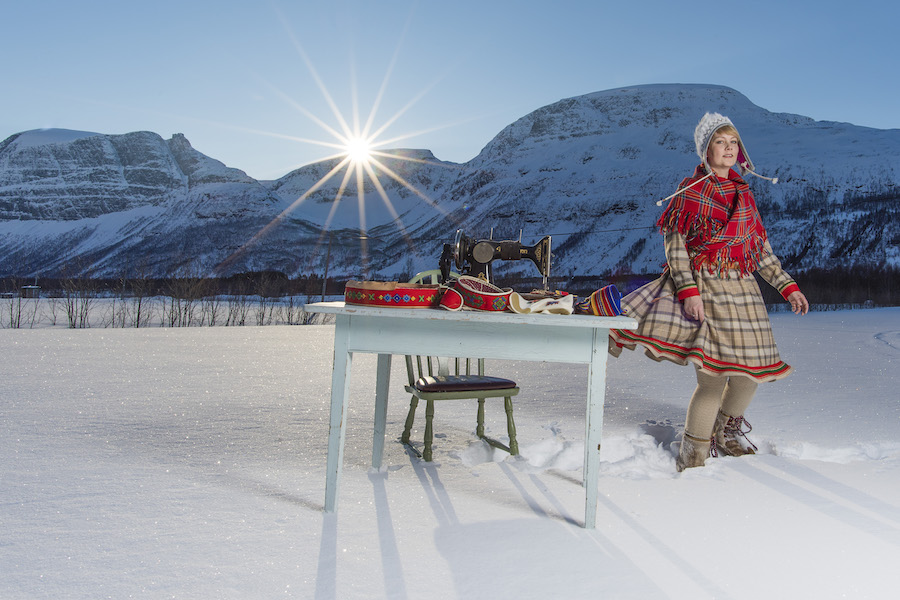

For three years, artisan Jorunn Løkvold from Manndalen has been immersing herself in riebangolli / mica as a research fellow at the Norwegian Crafts Institute. On September 4th, she will showcase her work through an exhibition at Davvi álbmogiid guovddáš / Centre for Northern Peoples.
When4 September
WhereDavvi People's Centre / Centre for Northern Peoples, Gallery
Time: 6.00 pm
Exhibition period4 – 18 September
Riebangolli is the Sami name I know from my childhood for fool's gold. My mother showed me this when we went for walks in the mountains where we live. It was a lovely ”stone” that glittered and shone, it resembled silver, so we picked it and kept it as our treasure, says Løkvold.
It wasn't surprising that it was precisely fool's gold she chose to focus on when she was selected as a scholarship recipient at the Norwegian Crafts Institute.
Løkvold is now ready to showcase her work and findings through the exhibition: Riebangolli / Fools’ Gold in Sámi Clothing Tradition.
The Sami people have used mica as decoration for a very long time. In sunlight, mica glitters like freshly polished silver, which is perhaps why it was used as a substitute for silver. We find descriptions of the use of mica in Sami clothing and accessories dating as far back as the 18th century. Belts, jacket collars, trim, bags, boxes and more were decorated with mica. For a long time, the technique was lost in our region, but in the 1980s it was brought back into use in connection with the revitalisation of coastal Sami clothing traditions.
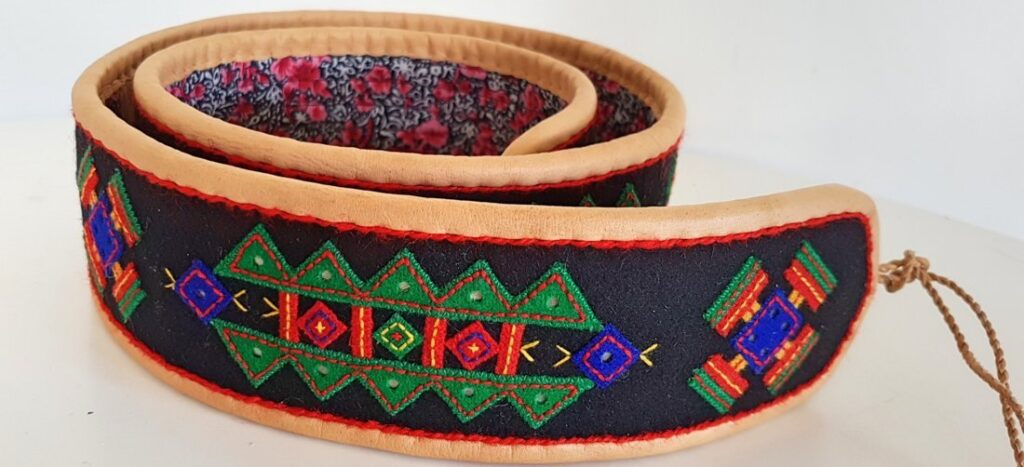
Made a copy of an old belt
Løkvold has spent hours in museums, where she has studied, among other things, the use of mica in old belts. The documentation regarding its use, location, and technique is very scarce, and this has at times been challenging.
- I have measured and drawn out the patterns, and I have also sewn a copy of an old belt. While working, I thought a lot about the working conditions of those who sewed the belts. About what tools and lighting conditions they had when they cut out and stitched the tiny pieces and sewed the tiny stitches.
In March this year, Løkvoldi travelled to Lovozero, or Lujávri, to find out more about the Kola Sámi's duodji traditions. She confirmed that they too have a tradition of using mica as decoration.
– These have been three exciting and educational years, during which I've had the opportunity to thoroughly immerse myself in various traditional techniques and materials. The knowledge and skills I've acquired have made me more confident in my profession, says Løkvold.
If you are Jorunn Løkvoll
- from Manndalen in Kåfjord
- driver Sáve design workshop, located in Manndalen
- took apprenticeship as Textile Maker in 2014
- given a series of courses in the duodji craft
- Scholar at the Norwegian Crafts Institute in 2016-2019
More about Jorunn Løkvold
Duojár's blog, Norwegian Institute for Handicraft
She delves into fool's gold, Future in the North (for subscribers)
Focus on cardigans, Future in the north