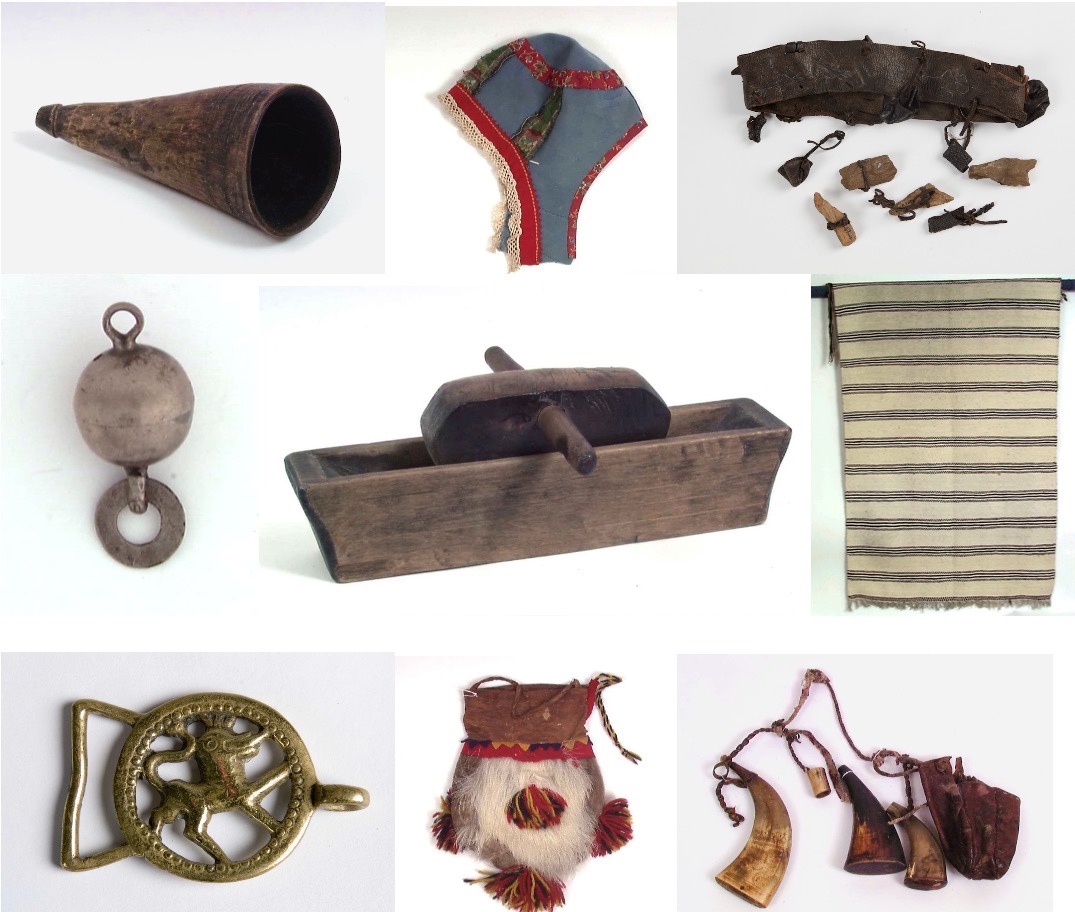
In the project Bååstede - re-establishing Sámi cultural heritage Should Sami cultural heritage objects be returned to Sami museums? A key starting point has been the right to manage and convey one's own cultural heritage on one's own terms. Sámi albmogiid guovddáš / Centre for Northern Peoples will have 24 objects returned, representing both material and spiritual culture.
In the 19th and 20th centuries, 4,200 objects were collected from all over Sápmi for the Ethnographic Museum of the University of Oslo, which later became part of the Museum of Cultural History. The objects were eventually deposited at the Norwegian Museum of Cultural History. This Sámi collection in Oslo was mainly gathered before there were any Sámi institutions. The cooperation agreement Bååstede - re-establishing Sámi cultural heritage signed by the Sámi Parliament, the Norwegian Museum of Cultural History and the Museum of Cultural History in 2012. On June 1, 2019, this historic agreement on the return of around 1600 artefacts from the Norwegian Museum of Cultural History and the Museum of Cultural History to the Sámi museums in Norway was signed in Guovdageaidnu/Kautokeino.
The repatriated cultural heritage shall be incorporated into its original language and cultural environments, and among other things, contribute to the revitalisation of art and cultural expressions, duodji (Sámi crafts), and language. In this way, the objects will become an important knowledge base for the Sámi people, who have lost much over the years as a result of Norwegianisation and war.
24 more items Sámi People's Centre / Centre for the North
The Sámi Centre for Northern Peoples is the custodian of the regional sea Sámi cultural heritage and cultural expressions, and is receiving back 24 culturally historical objects that have been registered and collected within our operational area. This includes Kvænangen, Kåfjord, Storfjord, Lyngen, Balsfjord, Ullsfjord, the Tromsø and Bardu areas.
The objects represent both material and spiritual culture. They belong to the region, to municipalities and to communities, and when placed in a cultural and historical context, the objects bring knowledge and understanding of living conditions, economy, sense of place, and cultural belonging.
Through the objects, duodji and craft traditions are conveyed, as well as livelihoods and resource use linked to subsistence economy and traditional practices such as farming, fishing and hunting, and reindeer husbandry. They are simultaneously carriers of traditional forms, symbolism, ornamentation, and elements of belief. This is of great value for the regional population's understanding of culture, local culture, and identity. They help to tell our coastal Sámi history and encounters between people and cultures.
Presentation of the items
Duodji and handicraft traditions
Some of the artefacts that Davvi álbmogiid guovddáš/Centre for Northern Peoples is having returned can be linked to different duodji and craft traditions. Such traditional artefacts can tell us a lot about people's ability to adapt and create based on resource availability. At the same time, they give us identity and a sense of belonging to Sámi culture, which during the Norwegianisation period was on the verge of disappearing from our daily lives. Traditional knowledge was lost, both how we make tools and how we use them, and the significance such artefacts had for belonging and identity, to nature, landscape, places, and in understanding how existence as a whole was connected.
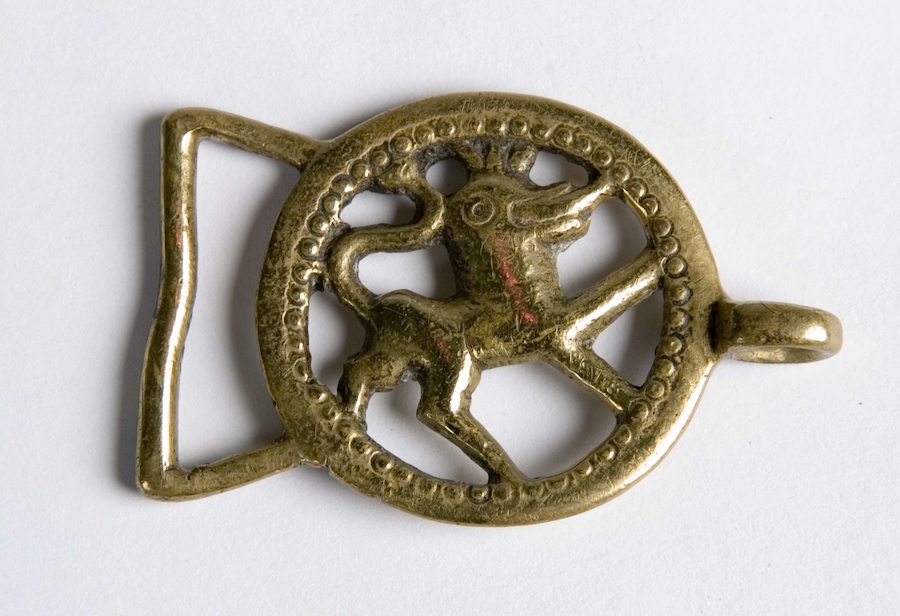
NFSA.1113 Guottahat / beltering
Guottahat / beltering. Photo: Anne-Lise Reinsfelt / Norwegian Museum of Cultural History.
The buckle is made of cast brass. It is decorated with a relief, a round plate depicting a mythical creature, a hoop at the edge and a transverse eyelet in the opposite direction. The width is 6.2 cm and the thickness is 4 mm. Belt buckles were attached to the belt, making it easy to keep necessary equipment such as knives, scissors, and sewing items readily available for everyday duodji and other work. Understood is a term used in older museum protocols, and is described as being used in the belt as a knife holder. (Káren Elle Gaup, 29.6.2017). NFSA.1113 guottahat / belt ring was received by the University Ethnographic Museum in 1908 from Deacon Bertrand M. Nilsen of the Sami Mission. In the letter from Nilsen, which included a list of collected items (22/1908), it states that this belt ring was found at Duikkášmuotki / Alteidet, Návuotna / Kvænangen, Nord-Troms. These areas have been, and still are, summer grazing areas for reindeer herding families from Kautokeino. The owner of the belt ring is unknown.
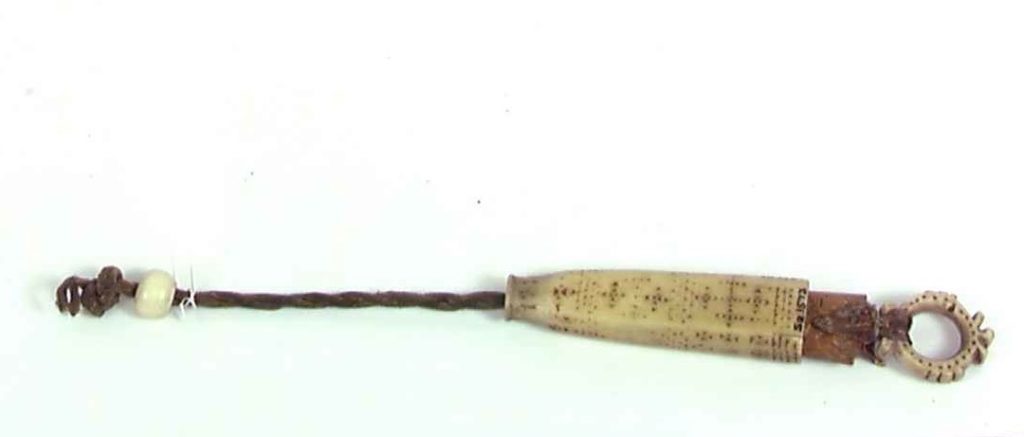
NFSA. 1573 Nállogoahti / nålehus
Sami Shoe/Hide Hut. Photo: Norwegian Museum of Cultural History.
A needle house is traditionally used to store sewing needles and thread. The needle house itself is made of horn/bone, and has a needle cushion made of leather and cloth that can be retracted into the house. The needle cushion's leather cord has a horn bead inserted at the top of the needle house, and a horn ring is attached at the end. The needle house is 22.2 cm in length, and the ring at the end is 2.3 cm. Both the needle house and the ring are ornamented.
NFSA. 1574 Nållogoahti/nålehus has the inscription: O J N. 1910, which indicates that the object was made in 1910. It was collected in Sálašvággi/Tromsdalen, Romssa/Tromsø and sold to the University Ethnographic Museum in 1918 by emissary Lars Larsen.
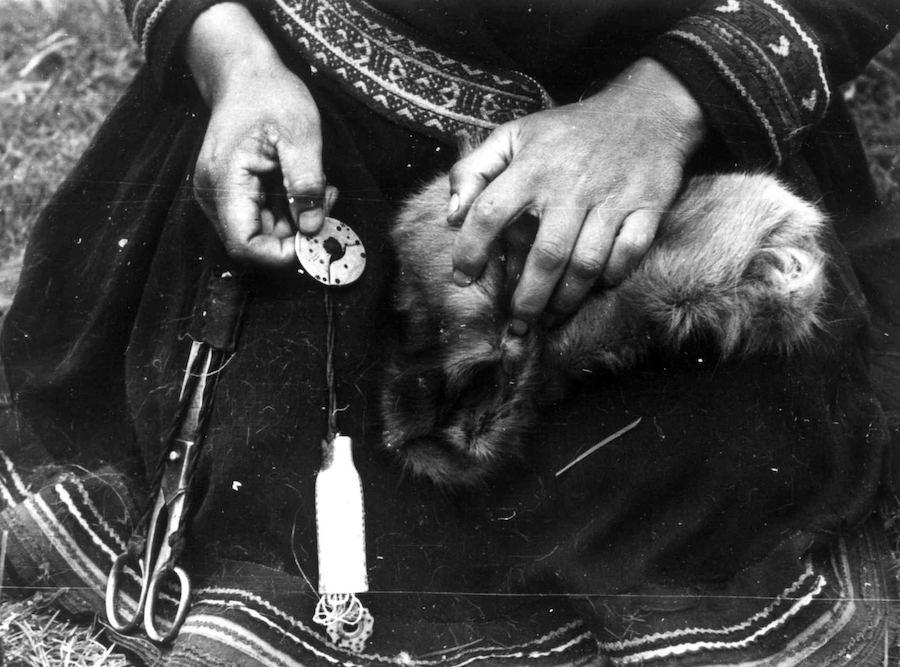
A person working with leather. Olderdalen, Kåfjord, Troms 1947. Photo: Anna Grostøl / Norsk Folkemuseum
The needle case is a practical and easily portable item. It also speaks of historical close relationships and interactions between nomadic Sámi and settled Sámi populations.
The photograph shows a woman working with duodji, and who is showing her horn belt buckle to the photographer. Necessary duodji tools such as a needle case and scissors are attached to the belt buckle.
The photograph is from Anna Grostøl's collections (Norwegian Folk Museum). Grostøl was a teacher and folklorist who gathered knowledge about handicrafts and craft techniques and working methods from all over the country. The collection contains photographic material and notes from her work in Troms and Finnmark between 1947 and 1955.
NFSA. 1568 Duhpátbursa / tobacco pouch
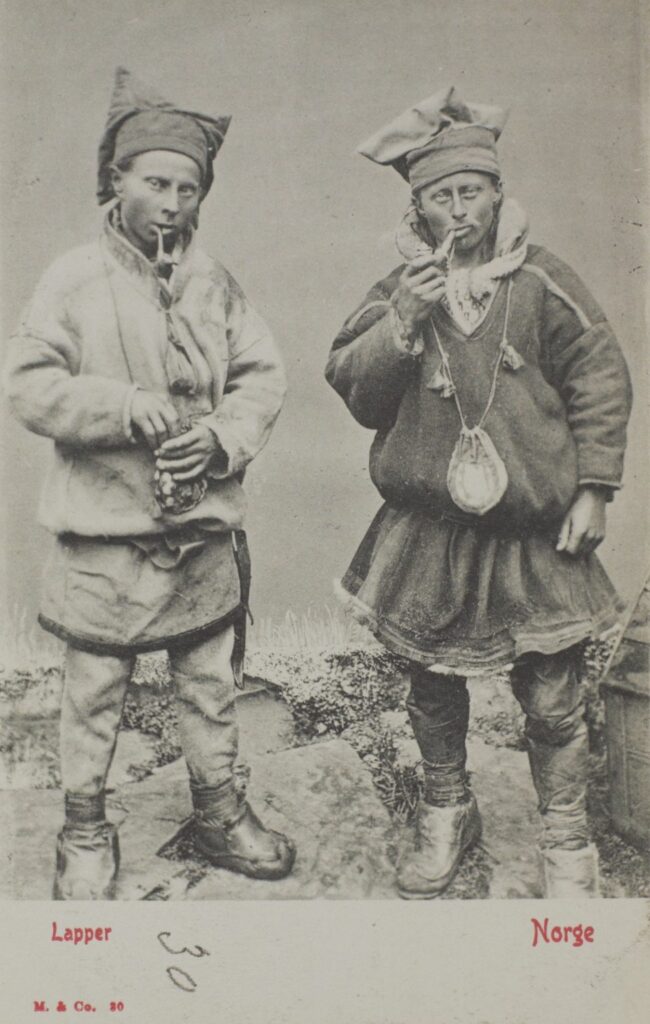
Traditionally, purses and bags have been made in various sizes and designs depending on their intended use. They were often finely crafted and beautifully decorated. Small purses were frequently worn around the neck to carry various valuables and other items, such as tinderboxes and tobacco.
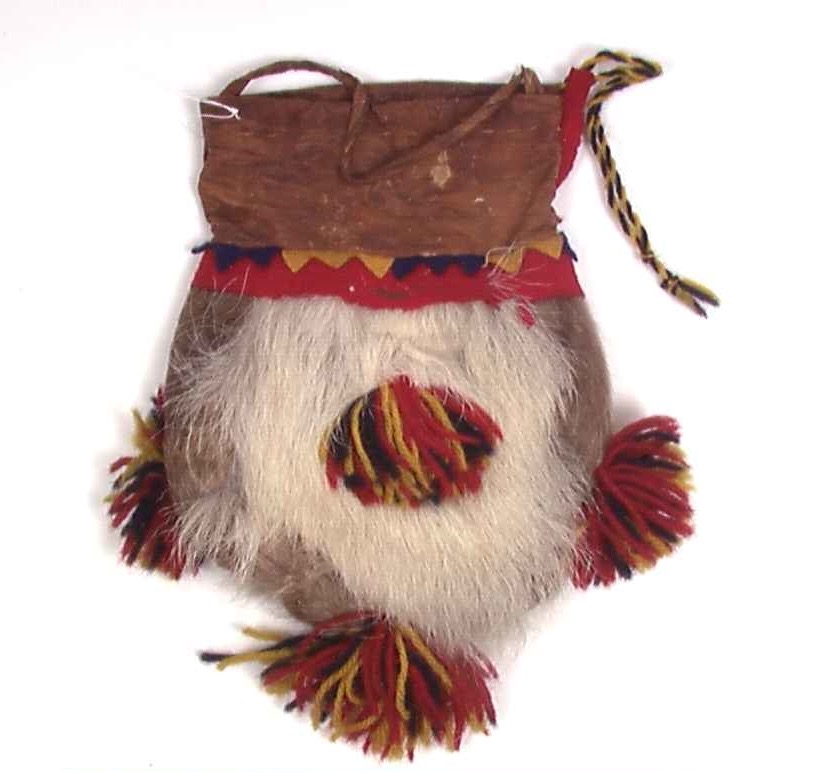
NFSA. 1568 the tobacco pouch is made of reindeer hide and decorated with red wool fabric and a zigzag border in yellow and blue, and tassels of wool yarn in red, yellow and blue. The pouch closes with a band of twisted wool yarn, and has a leather strap to hang it from. Length 20 cm and width, without tassels, 13.5 cm. NFSA. 1568 was collected in Sálašvággi/ Tromsdalen, Romssa/ Tromsø and sold to the University's Ethnographic Museum in 1918 by emissary Lars Larsen.
Tobacco pouch. Photo: Anne-Lise Reinsfelt / Norwegian Museum of Cultural History.Two young Sámi men with tobacco pouches and pipes. Title: Lapps. Norway. Postcard created by Mittet & Co, between 1900 and 1910. University Library of Bergen.
NFSA. 3138 Niikun / tape grinder
Grindstone/band grinder. Photo: Norwegian Museum of Cultural History. Photo: Norwegian Museum of Cultural History.
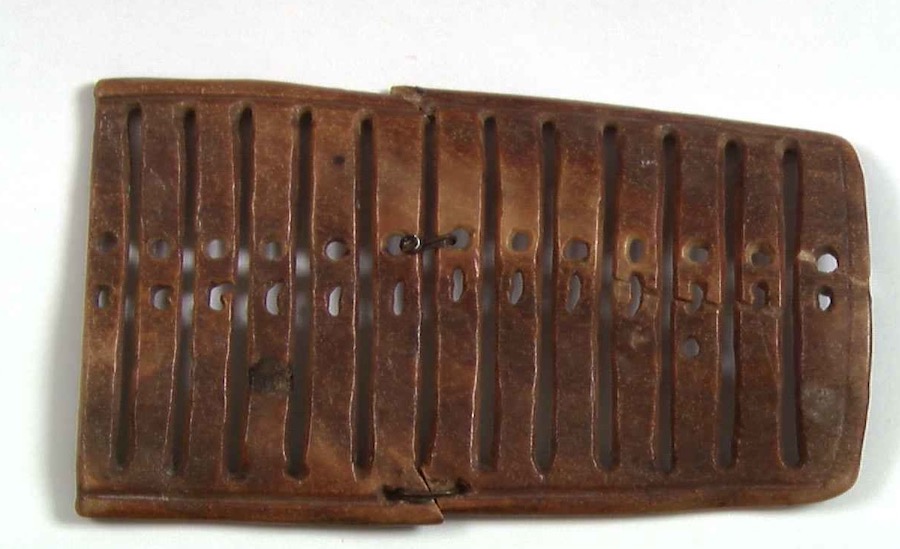
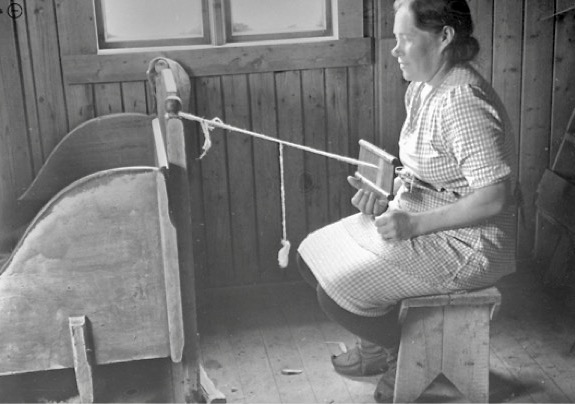
Belt grinders have been important in the manufacture of necessary textiles such as komagband and in the warping process of branch weaving.
This small niikun/band grinder made of horn. It shows signs of heavy use and has been repaired with steel wire. The length is 12.2 cm and the width 7 cm, it has 12 slots with a double set of holes. NFSA. 3138 was collected from Ytre Bakkemo farm, Biertávárri/Birtavarre, Gáivuotna/Kåfjord, and was accessioned into the Norwegian Folk Museum in 1952.
Petra Nilsen from Skárfvággi/Skardalen, Gáivuotna/Kåfjord, weaves komag footwear bands. Photo: Anna Grostøl in 1949 / Nord Troms museum.
Green weaving
Natural households were based on small resources that were fully utilised. Rátnugođđin/greneveving is a unique Sámi duodji tradition with roots dating back to prehistoric times. Ránu/grenes have been of great importance to the Sámi for centuries. The grenes are made of hand-spun wool, are water-repellent and user-friendly in all weathers. The nomadic settlers who came down to the coast were important users. They bought and bartered for grenes from settled Sámi, and used them as blankets to sleep under. They were placed in horse-drawn sleds as well as in reindeer sleds and pulks. Grenes that began to wear out were sewn together to form canvas for winter tents.
The weaving technique is of great cultural-historical value. It can be traced far back in time, to ancient Greece and up to Denmark in the Bronze Age. In Northern Troms and Finnmark, it has existed since prehistoric times.
'Rátnu' (or 'grener' in Norwegian) are woven on a simple upright loom, 'rátnostuolet' (or 'grenestol'). The warp, 'várfi', is made by simultaneously weaving an edge band which is sewn to the warp beam. Traditional 'grene' weaving on an upright loom is still a living tradition in Olmmáivággi (Manndalen), but 'ránut' (or 'grener') have been woven in the coastal areas of North Troms and Finnmark up until the 1940s-50s.
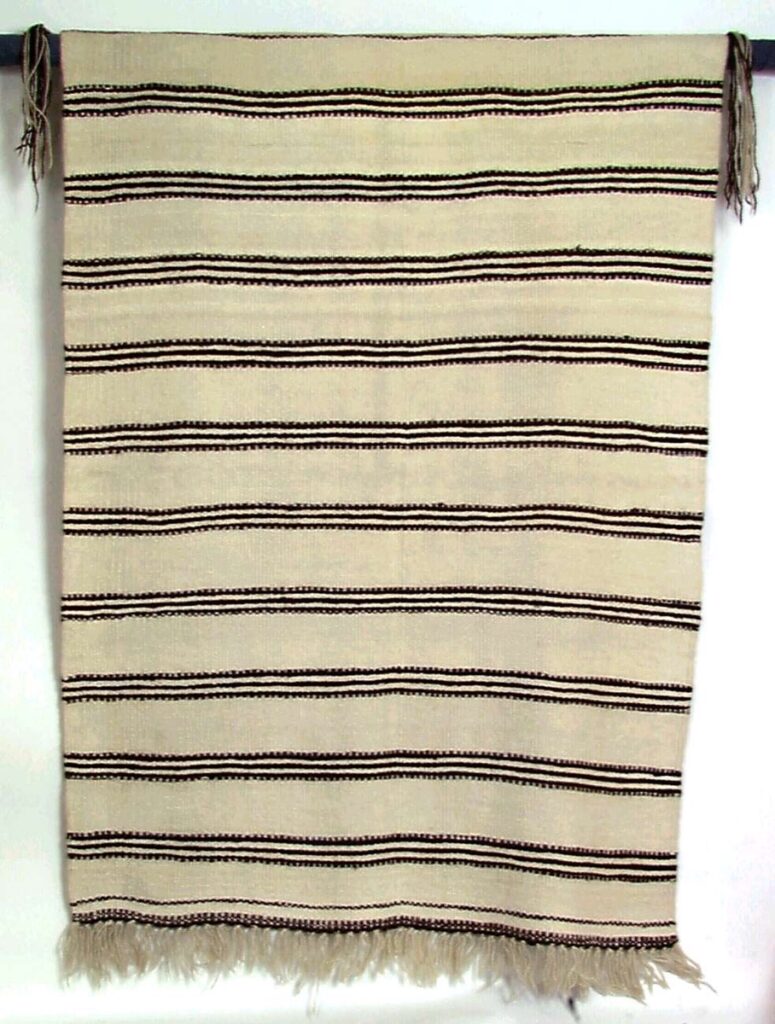
NF.1930-0122 Rátnu/ grene
NF.1930-0122 National Front / Green
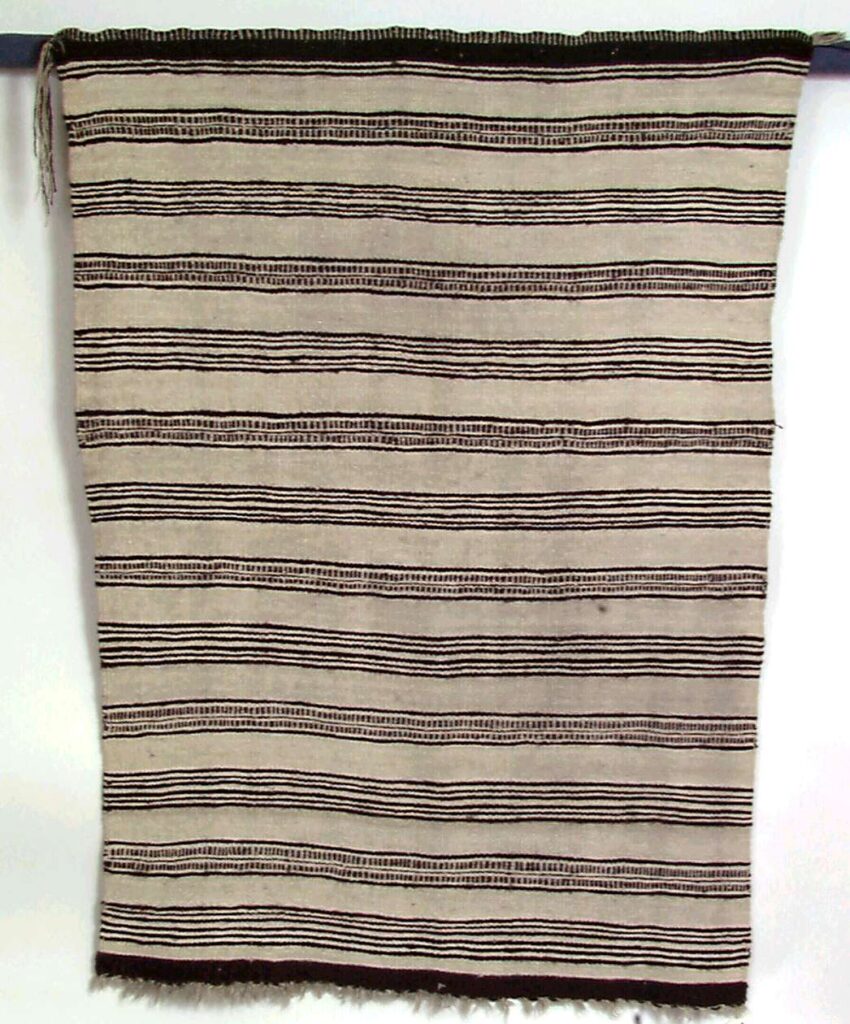
This is an old type of blanket. This type, with a border – wide, contrasting stripes at the top and bottom, and alternating simple borders, was common before the war. The base colour is natural white with two types of alternating borders in natural black. Length 204 cm, width 143 cm (widest part). The blanket was purchased in Dálošvággi/ Olderdalen, Gáivuotna/ Kåfjord from Alette Pedersen in 1930.
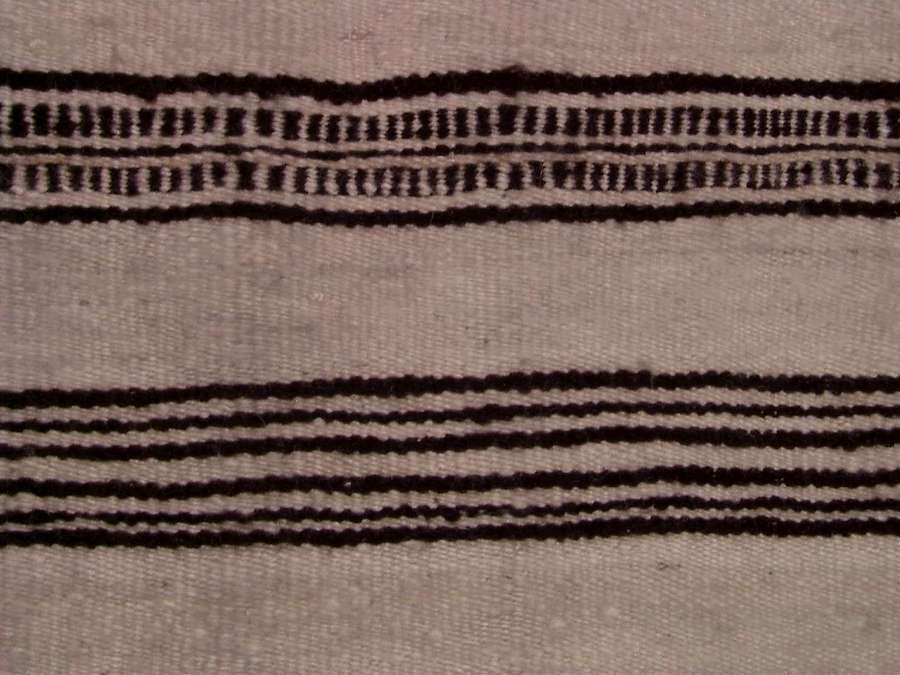
Detail of Rátnu/branch. Photo: Norwegian Museum of Cultural History.
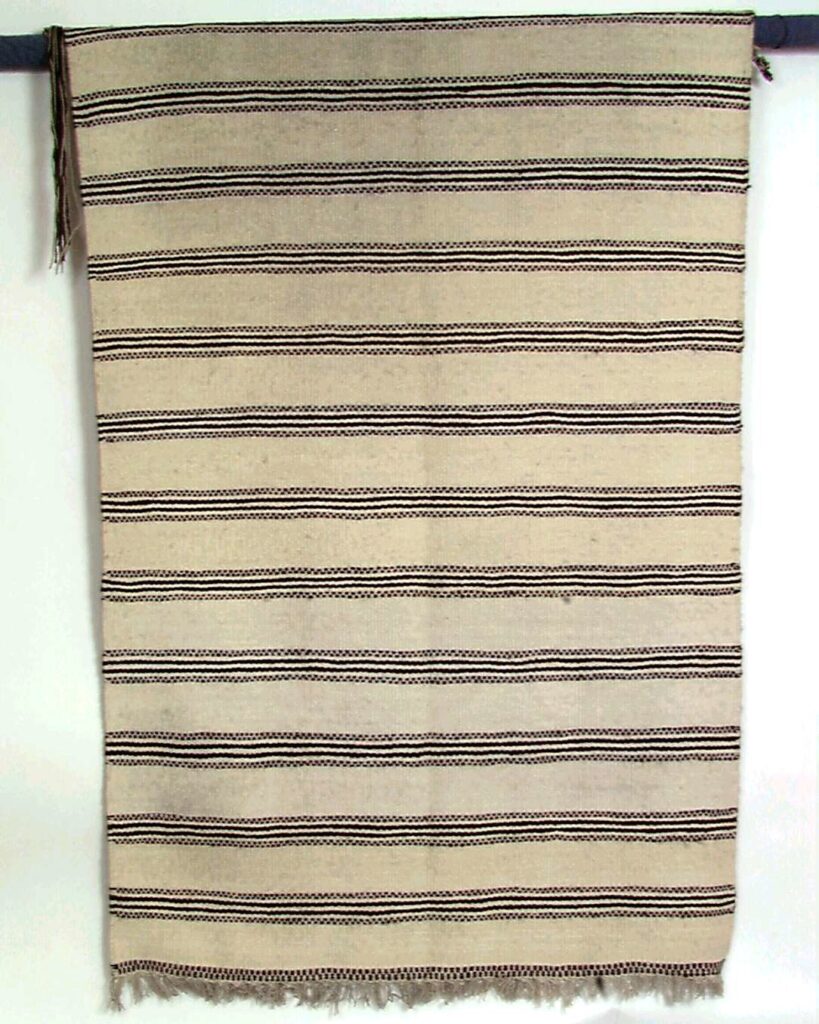
NFSA. 2734 Rate/ green
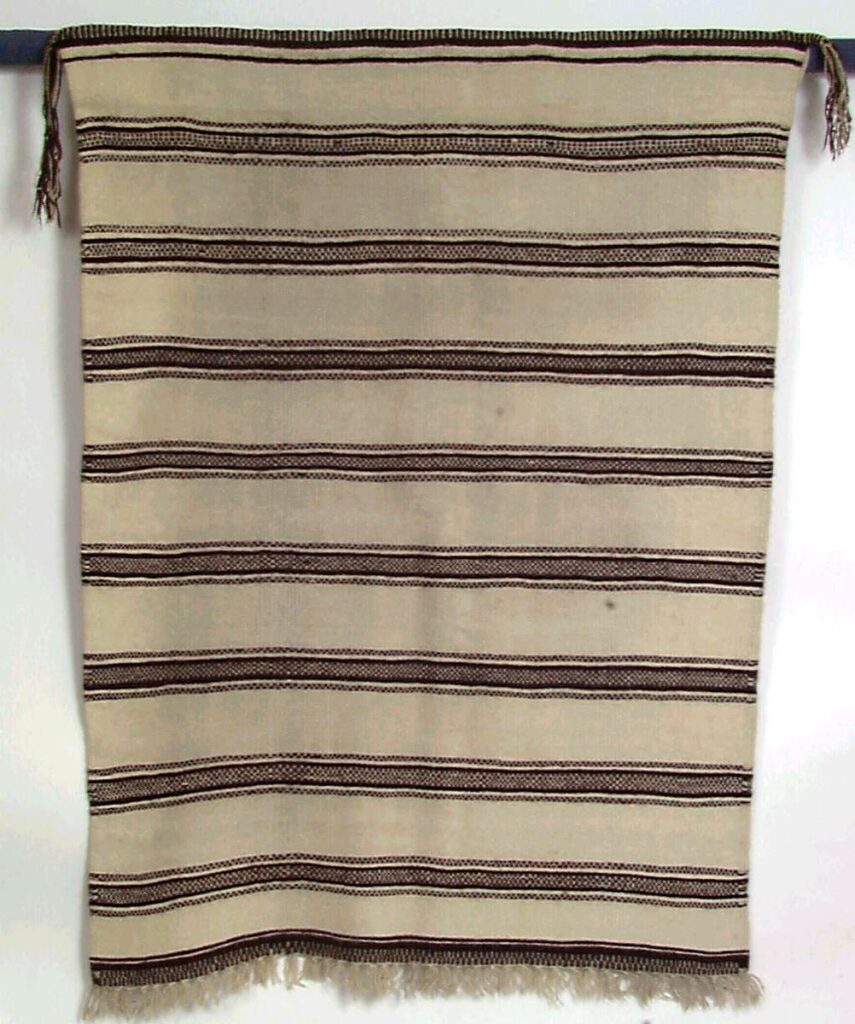
Natural white rátnu/blanket of an older type from Gáivuotna/Kåfjord. The rátnu/blanket is natural white with black wool trim and a repeating pattern stripe. Length 192 cm, width 140 cm.
It was deposited from the University's Ethnographic Museum in 1950, and found in the Norsk Folkemuseum's storeroom without a number in 1991.
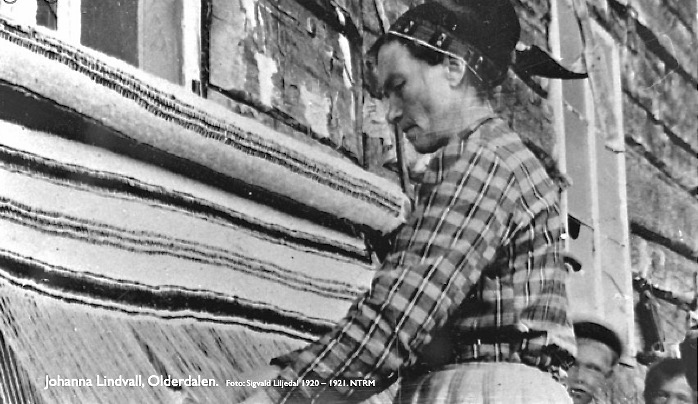
NFSA. 2734 Rate/ greenJohanna Lindvall weaving branches in Dálošvággi/Olderdalen, Gáivuotna/Kåfjord. The branch weaving is set up against the house's outer wall. The photograph was taken around 1920 by Sigvald Liljedal. Nord Troms Museum.
NFSA. 2733 Rátnu/green
NFSA. 2733 Ratnu/green
This rug is of an older weave type and has a traditional off-white base colour with a repeating pattern stripe in sheep black. The beginning and end of the rug are marked with simple black stripes. NFSA. 2733 was purchased in Olmmáivággi / Manndalen, Gáivuotna / Kåfjord. It was found without a number during clearance in the textile storage at the Norwegian Folk Museum. Catalogued accession 1800–1900.
NFSA. 3451 Red / Green
NFSA. 3451 rátnu/ grene
Natural white knitted item/garment with a repeating pattern band in sheep's black from Olmmáivággi/Manndalen, Gáivuotna/Kåfjord. This garment is of a more standardised type, without a stripe and with wider bands, which became more common from the 1950s. Purchased for the Norwegian Museum of Cultural History in 1955.
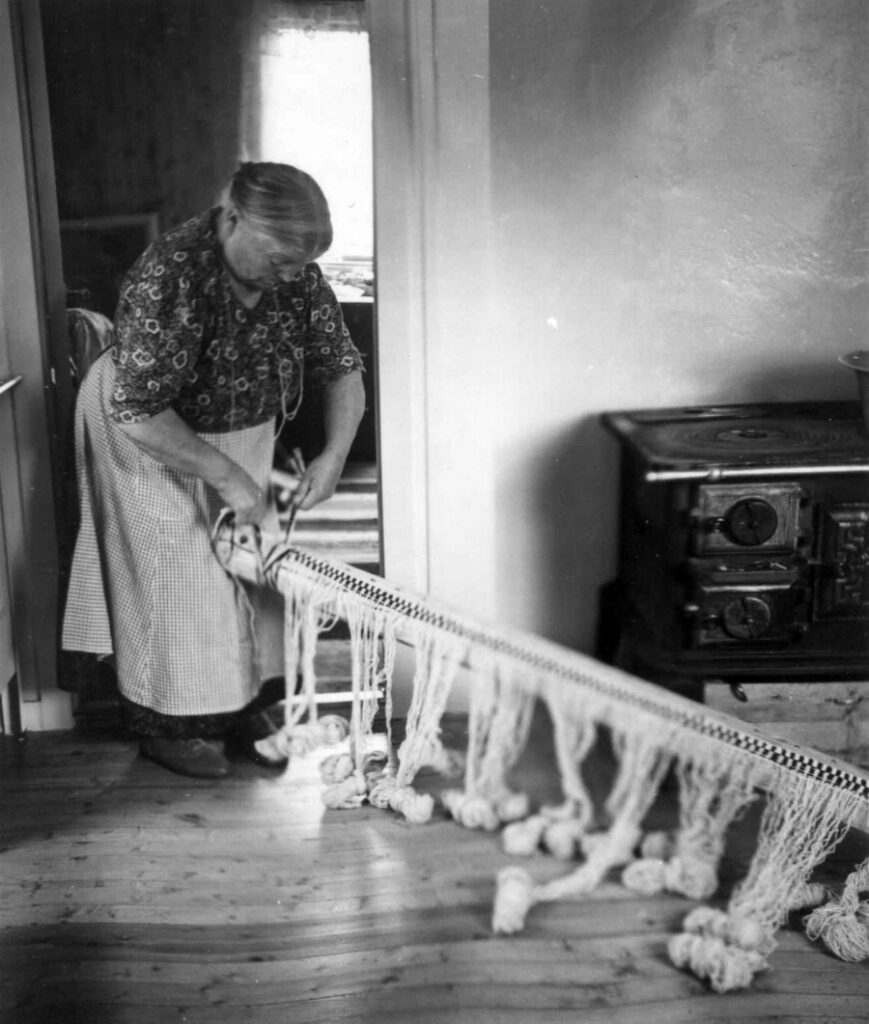
The 'rátnu' / 'grena' is produced by Anne Hansen, Olmmáivággi / Manndalen, and measures 220 cm in length and 140 cm in width. The entire process of creating the 'grena', including spinning, warping, and weaving, was documented, photographed, and partially filmed by Marta Hoffmann in 1955. Hoffmann was a curator and textile researcher at the Norsk Folkemuseum (Norwegian Museum of Cultural History), and she specialised in handicrafts, textiles, and textile production processes. She was involved in the revitalisation of the 'grenevev' weaving tradition in Olmmáivággi / Manndalen following the Second World War.
Anne Hansen ties the runner of the saddle rigging to the beam. Manndalen 1955. Photo: Marta Hoffmann / Norsk Folkemuseum.
Kleskoder
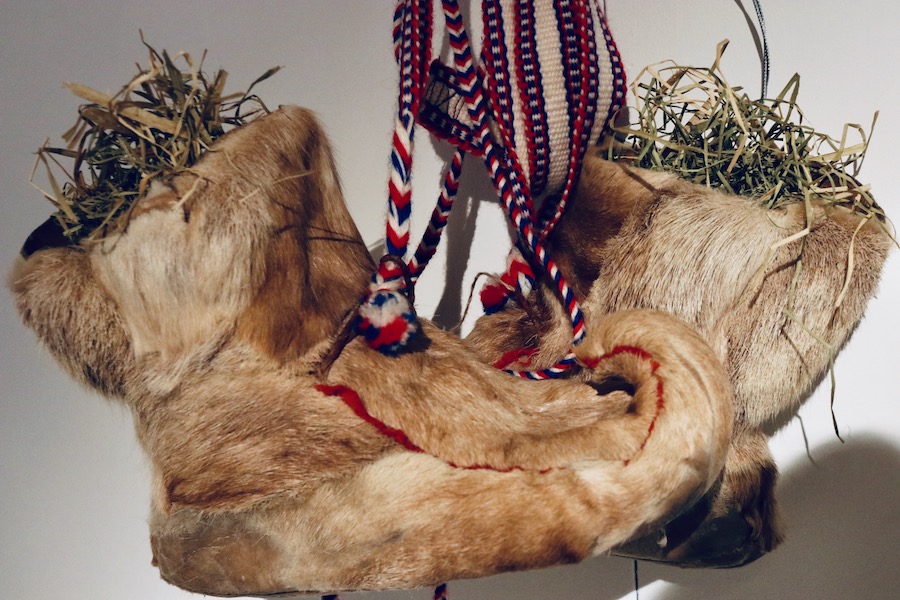
At the Norwegian Museum of Cultural History, there is little object material from Sámi clothing traditions registered as being from our region, with the exception of some traditional hats, shoe laces and shoes, parts of the clothing which were also the last to go out of use.
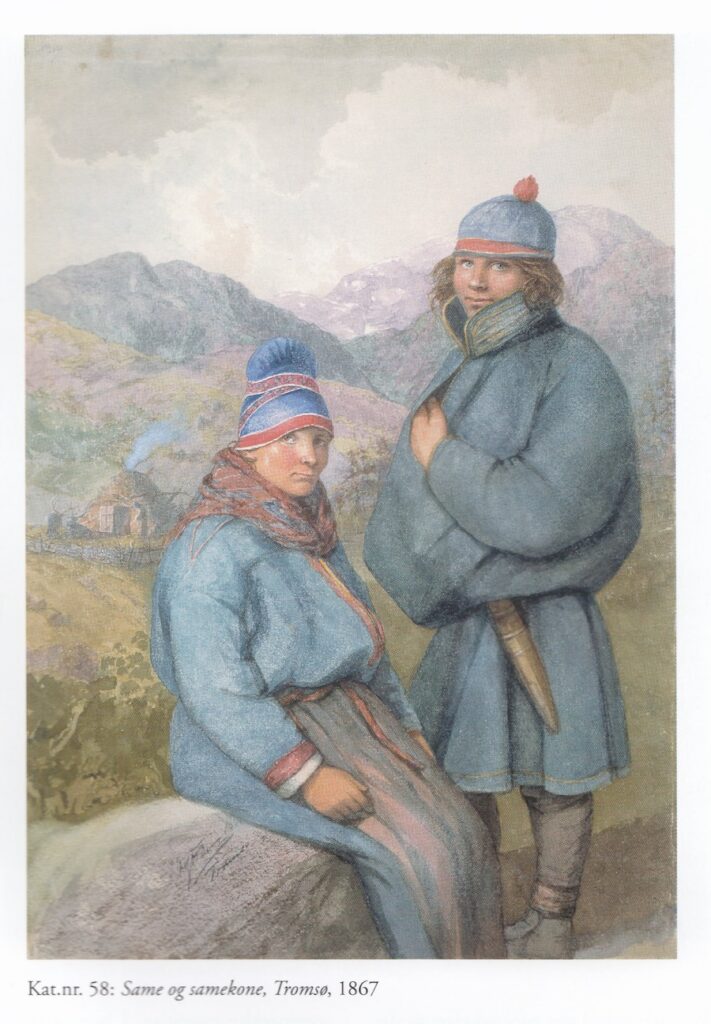
Same and Same Woman, Tromsø, 1867. Watercolour by Hans Johan Fredrik Berg. The National Museum.
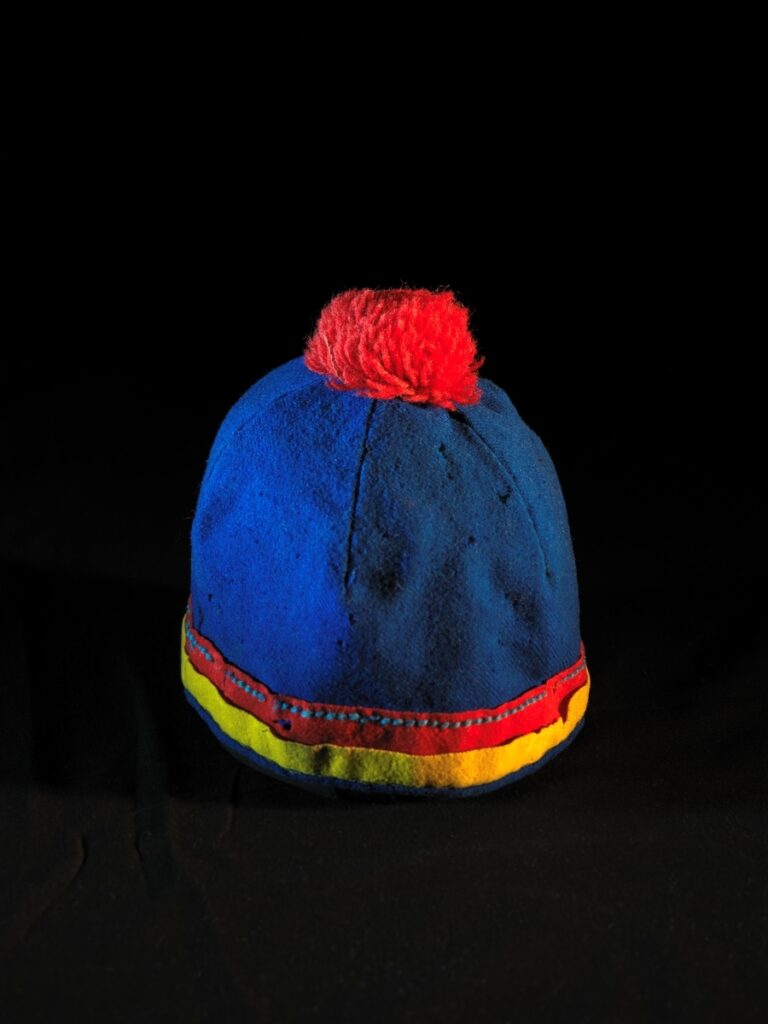
NFSA. 2630 Birasgahpir (wolf hat Beanie
Headdress (hat / man's hat). Photo: Norwegian Museum of Cultural History.
The hat/cap is sewn from blue wool fabric and edged at the bottom with red and yellow wool fabric. Red wool yarn tassel on top. Height 17 cm, diameter 18 cm. This type of man's/boy's hat is described as being used in the coastal areas of Northern Troms and Finnmark. The hat was collected in the Tromsø area and entered the Norwegian Folk Museum in 1950. (Deposited from the University Ethnographic Museum).
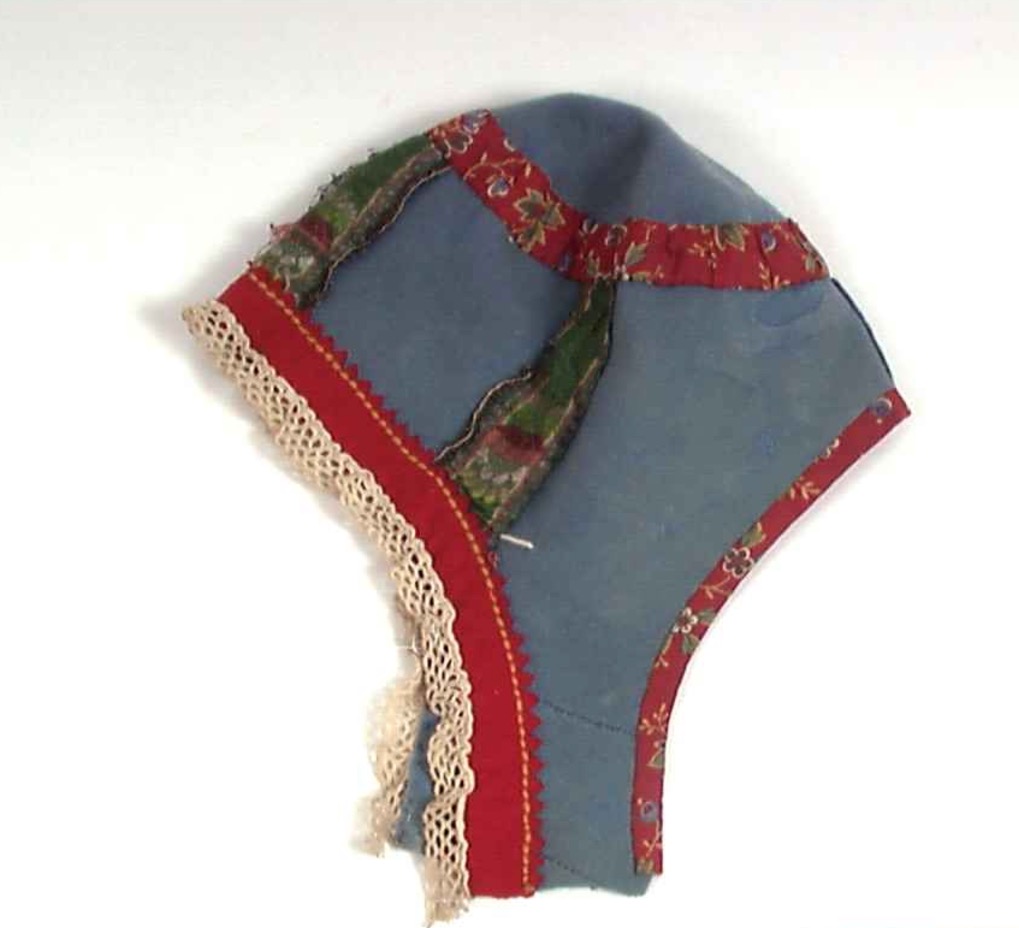
NFSA. 2631 Nissan Qashqai/ Women's hat. Photo: Norwegian Folk Museum
Cap / women's hat. Photo: Norwegian Museum of Cultural History.
The Nisson gahpir / woman's cap is a cap of the "kysel" type, made of blue wool fabric and decorated with floral patterned cotton fabric and silk ribbon, with a white lace trim at the front. Height from the front upwards: 13 cm, diameter 16 cm. NFSA. This is a type of woman's cap traditionally used by the nomadic Sámi population who came down to the coastal areas. Similar caps of the "kysel" type were also used in the coastal areas of Northern Troms and Finnmark. The woman's cap was collected in the Romsa/Tromsø area and was acquired by the Norwegian Folk Museum in 1950. Deposited from the Ethnographic Museum of the University.
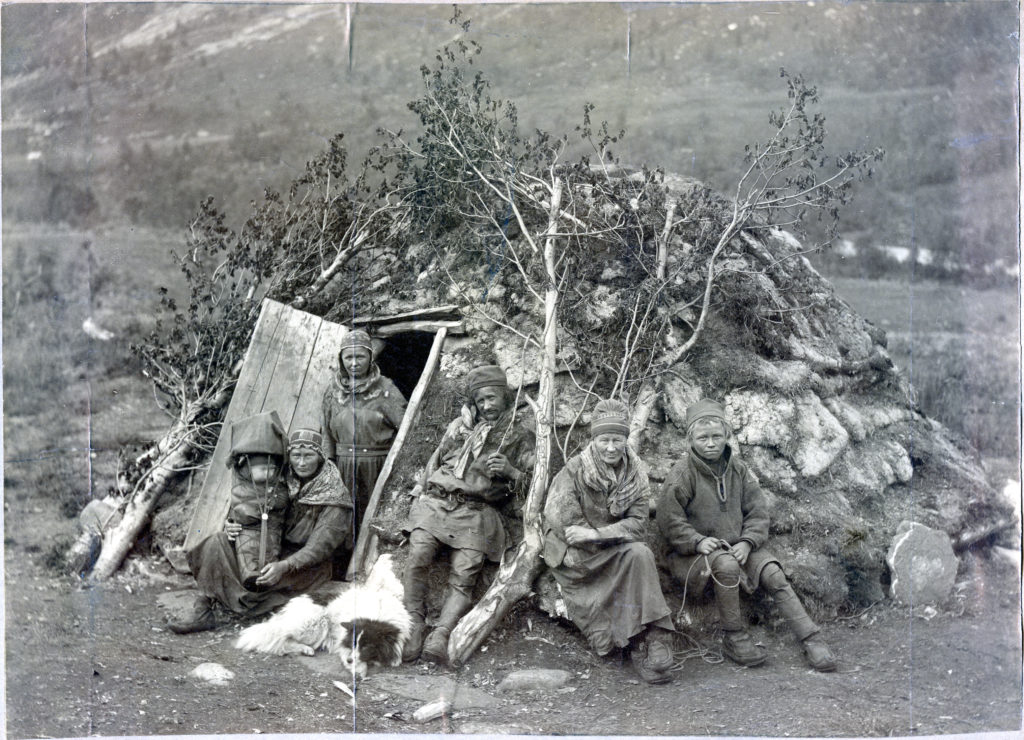
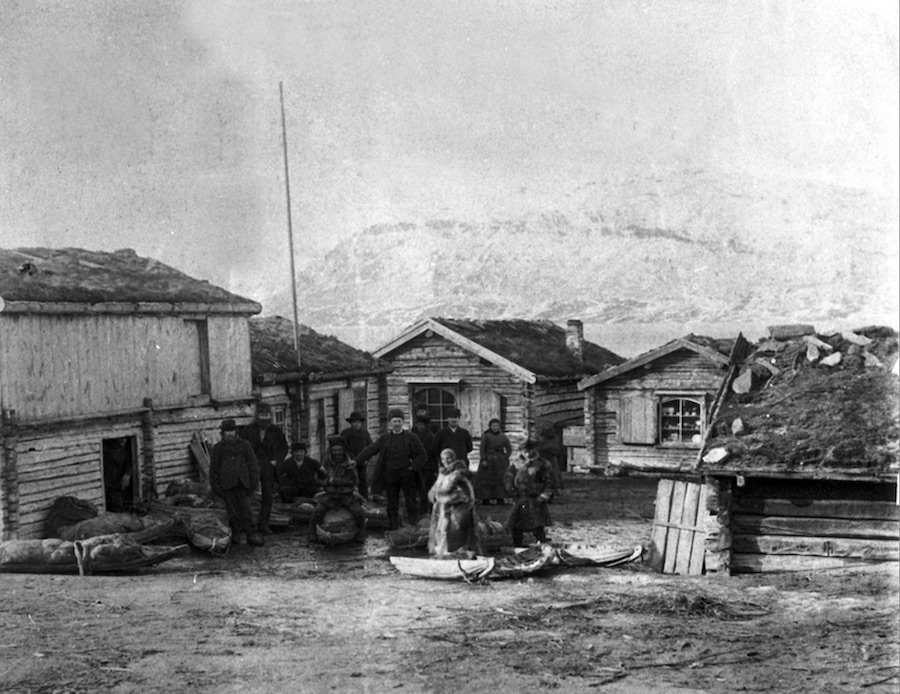
Sounds from Karesuando at a turf hut, on summer pasture in Tromsdalen. Photo: Museum of Cultural History, University of Oslo.
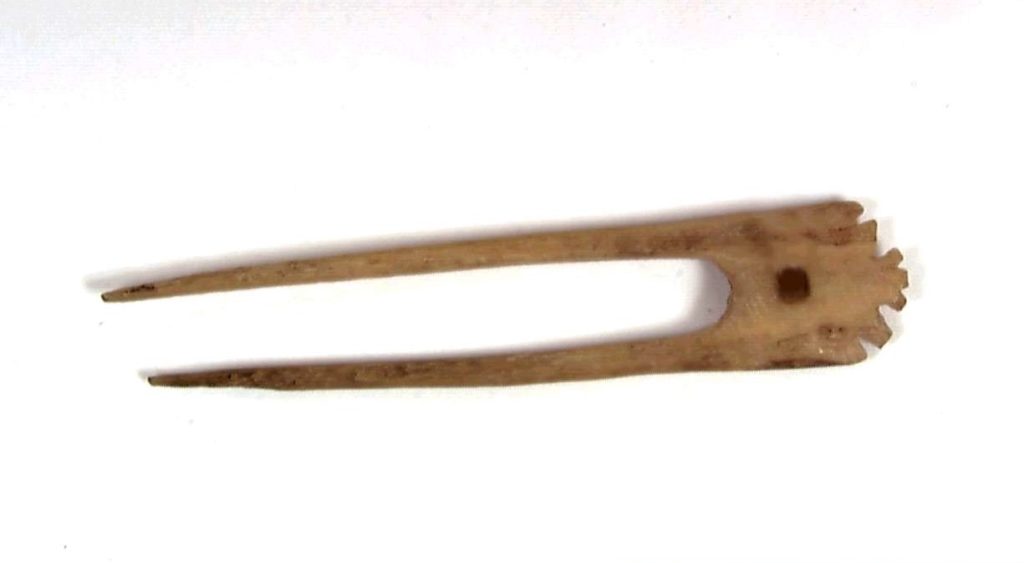
NFSA. 0475 Vuoktasoađis/ hair pin
Hairpin. Photo: Norwegian Museum of Cultural History.
The hairpin is made of bone with two prongs and decorative carvings at the end. Length 9.4 cm and width 2 cm. The object was purchased in the Tromsø area in March 1907, for the University's Ethnographic Museum by Mrs. Ingertha Hagemann, widow of forest manager Axel Hagemann.
The hairpin holds both practical and aesthetic significance. It is practical for holding hair in place, and can tell us about people's need and ability to also decorate a small, simple object.
NFSA. 2544 Sirpe / sigd
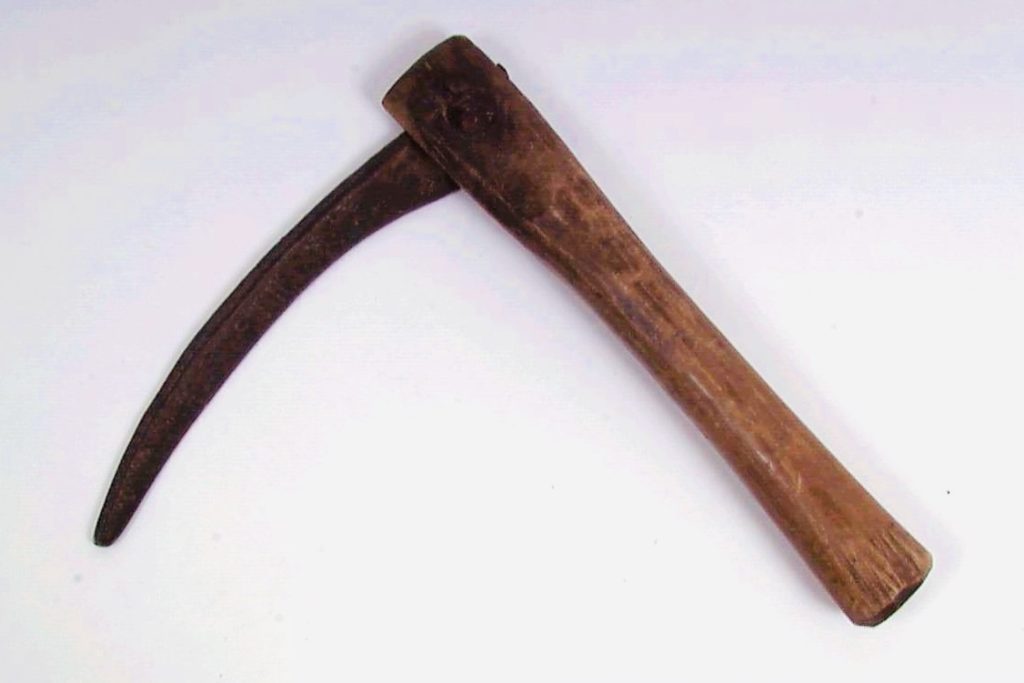
The 'sirpe' / 'sigden' consists of an iron blade riveted to a wooden handle. The blade measures 21.5 cm in length and 2.8 cm in width, while the handle measures 24.3 cm in length and 3.6 cm in width. The object was acquired by the Norwegian Folk Museum in 1949, collected by the linguist and cultural researcher Asbjørn Nesheim. It was used in Moskavuotna/ Ullsfjord (Sørfjorden), Ivgu/ Lyngen.
Sirpe / sigd. Photo: Norsk Folkemuseum.
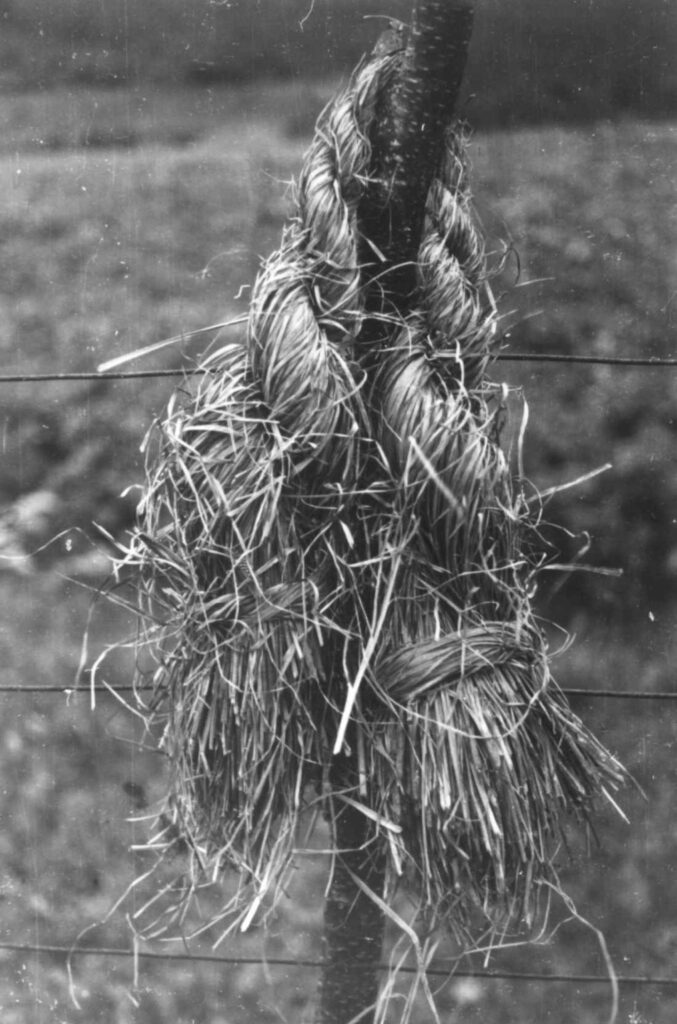
Sirpe has also been referred to as sennegressigd. The object also tells of clothing traditions; it was widely used for cutting moor grass which was a necessity for footwear, and was changed regularly. From Ole Thomassen's descriptions: «In Lyngen, moor grass is prepared only by cutting it with a sickle and binding it in the same shape as corn sheaves, though not nearly as thick sheaves as corn. Each sheaf is then divided into two parts from the binding at the top. Both parts are twisted together like rope and called" information management. Into such information management made with a little finger-length braid together at the top, forming what is called bilingual. »These are dried and then ready for use." (Thomassen 1999: 65-66).
Reindeer moss drying on a stick. Olderdalen, Kåfjord, Troms 1947. Photo: Anna Grostøl / Norwegian Museum of Cultural HistoryScales with fenugreek. Owned by Nord-Troms Museum. Photo: Torun Olsen Wernberg
Everyday life and self-sufficiency
In natural households, people made their own necessary tools and implements for everyday use, such as planes and knives for various purposes. It was also important to be able to produce essential practical and functional objects oneself, such as looms for band weaving and handles for tools like sickles, rakes, and axes, as well as, among other things, containers for storage and use in households. Such objects represent material culture and have a greater significance in themselves. They tell us about the person behind the object, its use, and the entire society it was part of. We can distinguish different dialect areas and different cultural areas where Sami populations are found. Duodji objects show different place characteristics, which are also based on changing cultural impulses through centuries manifested in decoration, design, and ornamentation. Many of the objects that are repatriated are richly ornamented and are sources of new cultural knowledge.
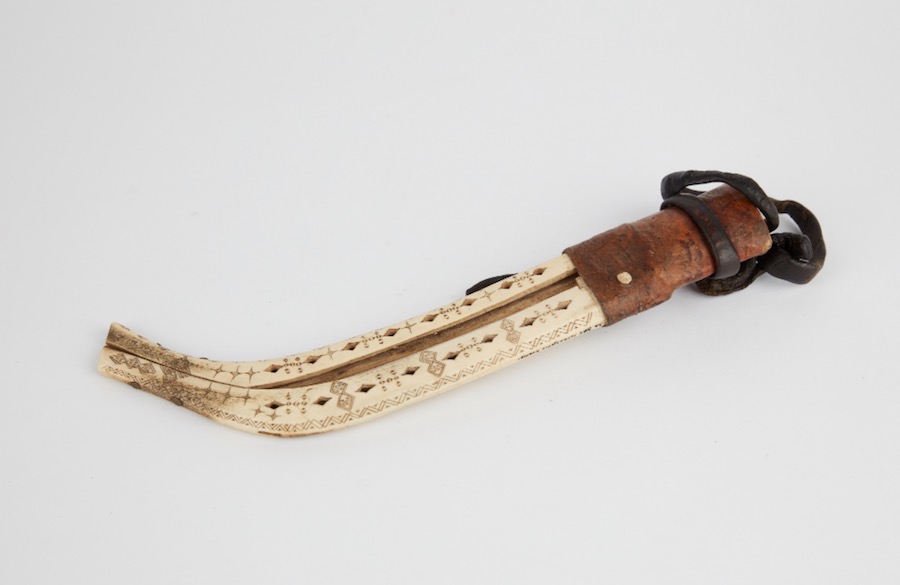
NFSA. 0309 Knife with sheath
Knife with sheath. Photo: Norsk Folkemuseum.
This is a traditional Sami knife with a horn sheath. The sheath is pierced and beautifully ornamented with pierced and incised geometric motifs, crosses and zigzag borders.
The perforated sheath also has a practical purpose; a damp knife blade inserted into the sheath will dry quickly thanks to good ventilation. The knife's length is 33.6 cm and its width is 5 cm.
Yngvar Nielsen, Head of the University's Ethnographic Museum (1877-1916), purchased the knife in July 1891 from Sámi people from Jukkasjärvi who were spending their summer in Skoelvdalen (Várdnoljohka/Skoelva) in Bardu. «A supplement to these Lappish collections was acquired in July 1891, on a short trip that Dr. Nielsen took in Tromsø Amt at the time, during a visit with Lapps from Jukkasjervi, who were spending their summer in Skoelvdalen, by Bardudalen». (Nielsen Y. The University's Ethnographic Collections 1857-1907 s. 74).
NFSA. 0301 horn spoon
Caribou trousers/Reindeer trousers. Photo: Norwegian Museum of Cultural History.
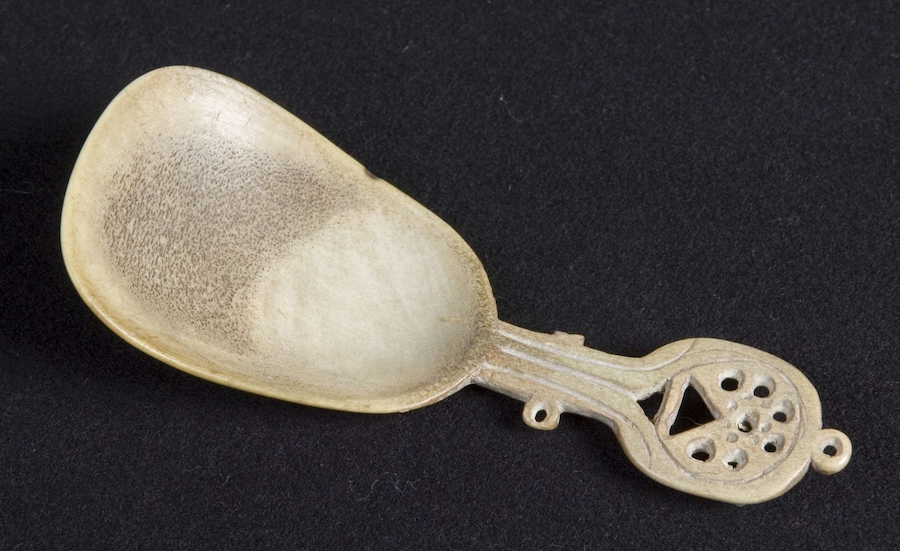
A small, traditional Sami čoarvebaste/horn spoon. The handle is ornamented with pierced round and triangular ornaments, and incised lines that follow the shape. A horn spoon is an example of an object that the Sami developed early on. Sami spoons are known for having short handles, and the spoon itself can be oblong, round, or pear-shaped. The horn spoon, NFSA.0301, tells of a Sami aesthetic language that goes far back in history. The shape and ornamentation are preserved in the production of spoons even today. This spoon was purchased for the Ethnographic Museum of the University in July 1891 by Yngvar Nielsen, during his journey to Skoelvdalen (Várdnoljohka/Skoelva) in Bardu.
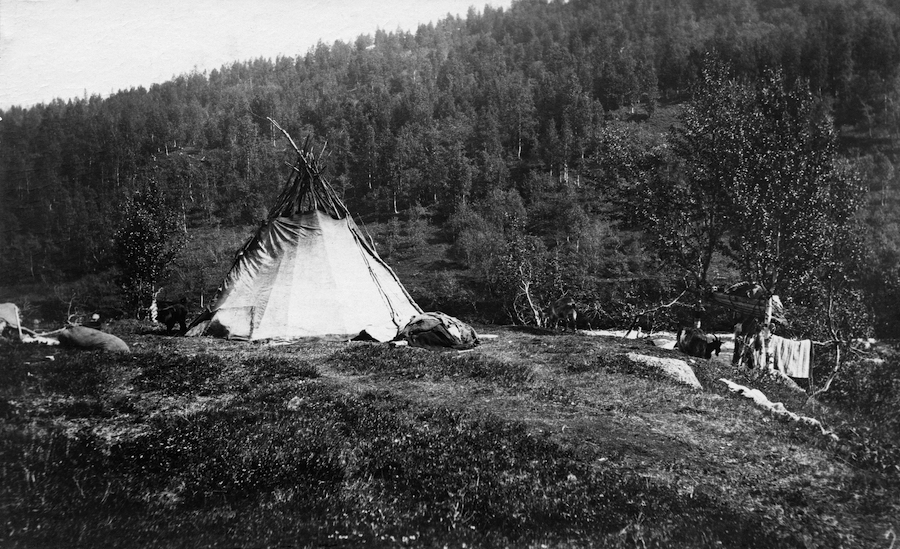
Sámi encampment in Skøelvdalen in the then Dyrøy parish, Troms. Tent. Lavvo.
A knife with a sheath and a horn spoon are among the cultural historical artefacts that tell of the spread of reindeer husbandry and the communication between different ethnic groups who lived side by side along the coast for parts of the year.
NFSA. 3134 Box
Box / case. Photo: Norwegian Museum of Cultural History
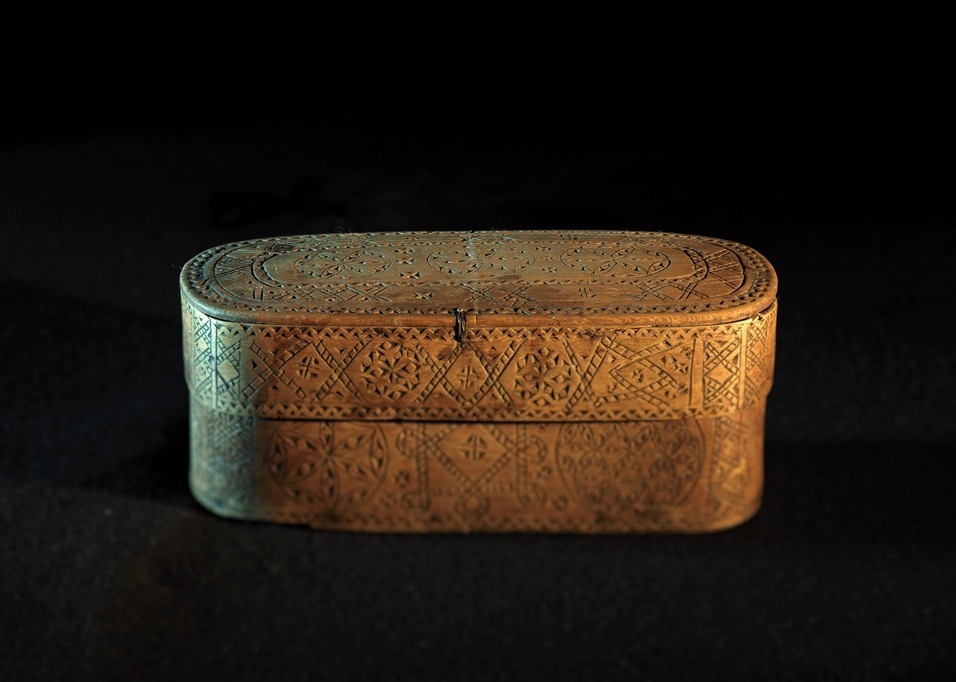
NFSA. 3134 is a beautiful small skáhppu/box with a wooden lid. Both the box and lid are 'swept' and joined with small rivets and brass wire. Length 26 cm, height 10.5 cm, and width 12 cm. The box and lid are richly decorated with carvings. The ornamentation is of a North Sámi type; larger motifs such as circular ornaments and plaited patterns in square shapes are combined with smaller pattern elements, and parallel lines put together into zigzag borders. NINTSLIK 81 is inscribed on the box. This is a very old item and is registered in the Norwegian Folk Museum's archive as possibly being from 1781. It is stated to be from Njoaski/Njosken, Moskavuotna/Ullsfjord.
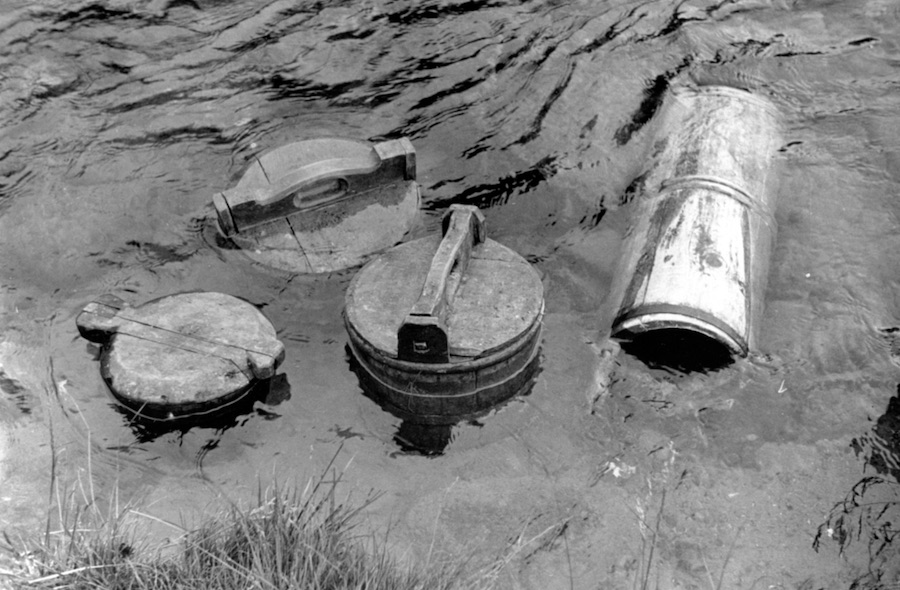
Dairy products to be cooled, in Dálošvággi/ Olderdalen, Gáivuotna / Kåfjord. Photo Anna Grostøl, 1949. Nord Troms Museum.
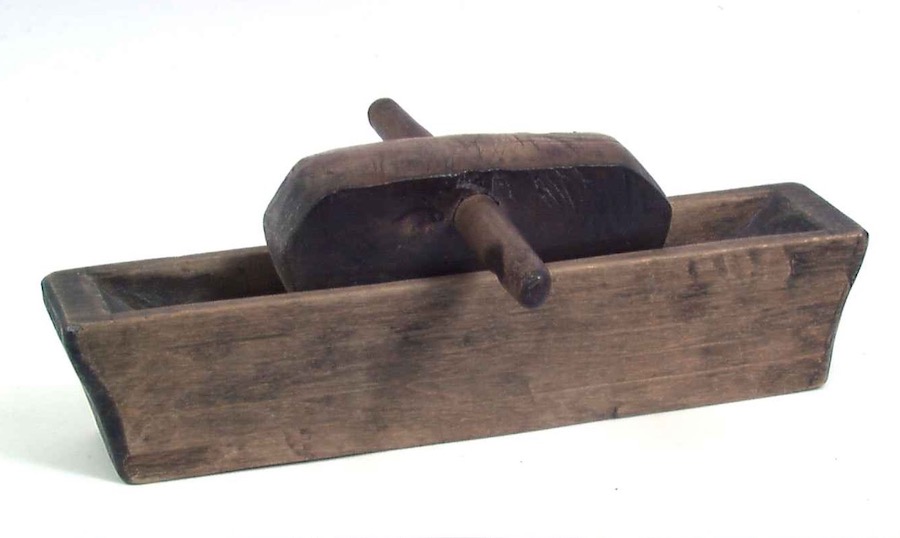
NFSA. 1564 Coffee grinder
A coffee grinder is an oblong wooden grinder with a container and a roller with a handle. The handle has simple notches. Container length: 26.4 cm and width 5.2 cm. Width of the roller including the handle is 16.5 cm. The grinder was collected in the Báhccavuotna / Balsfjord area and sold to the University Ethnographic Museum in 1918, by emissary Lars Larsen.
Coffee mill / coffee grinder. Photo: Norwegian Museum of Cultural History.
A similar type of grinder is described by Konrad Nielsen as a tool for crushing coffee beans (Nielsen 1979: 373). In the notes of schoolteacher Ole Thomassen from 1896-98, he describes how such a coffee grinder is used:
Coffee beans are generally ground in a grinder. Occasionally, though rarely, I have seen them crushed in a special type of mortar. This consisted of a small block of birch, shaped on the inside like a funnel, such that the hole, which tapers sharply at its innermost end, did not go all the way through the block. The so-called 'twister', also made of birchwood, was like a peg, roughly the same thickness at both ends and long enough to provide a firm grip, and of sufficient thickness to almost fill the lower end of the hole. The twister was then inserted into the hole first, so that the end rested in the bottom of the hole, after which coffee beans were placed in the funnel-shaped hole. The upper end of the twister was gripped firmly and rotated, so that the circle was not made larger than was easily achievable, and it was also continuously pressed down towards the bottom of the hole during the twisting. The crushing of the coffee beans thus took place at the bottom of the hole. It was quite quick and easy to grind coffee beans with such a mortar.
Ole Thomassen. The Sami's relationship. Sámi Giellaguovddáš/ Sami Language Centre, Kåfjord Municipality 1999. p. 58).
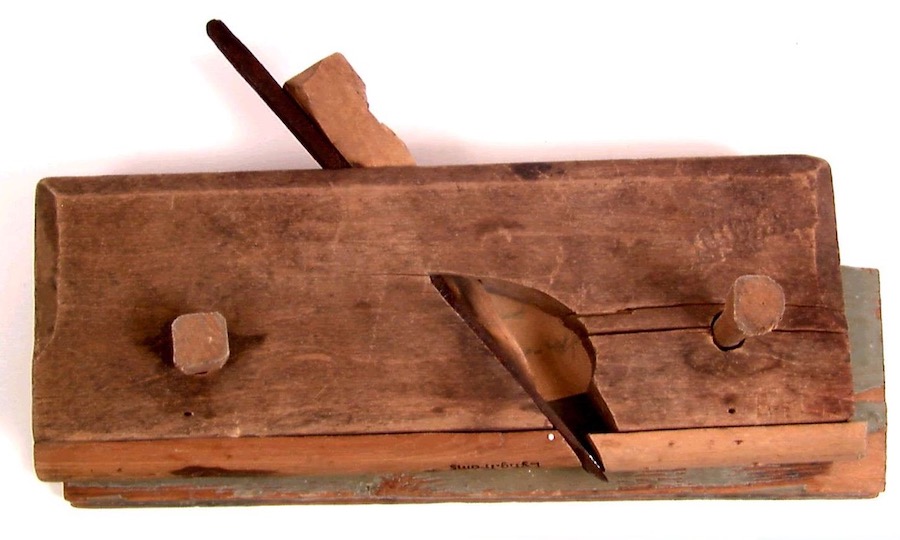
NFSA. 2547 Plane
PLANE / SHOE. Photo: Norwegian Museum of Cultural History.
Heavval, the plane was collected by Asbjørn Nesheim in Biertávárri / Birtavarre, Gáivuotna/ Kåfjord, 1949. This is a square plane made of birch with a narrow blade of forged iron. Length 21.8 cm, width 7 cm.
Planes were used for carpentry, boat building, making sledges, various necessary tools, and repairs, among other things. Planes were made according to their intended use, and this plane is designated as a ski plane in older museum records. It is described as Noggin-shiner, Autumn, A gouge for making hollows in Konrad Nielsen, Systematic part 1979. 390 pp., p. 257.
Hunting and trapping
Descriptions from early times tell that the region was rich in wild reindeer, bears, otters, foxes, squirrels, beavers, and ptarmigans, and place names such as Goddejávri/Wild Reindeer Lake and Čavkkus/The Otter provide information about hunting and trapping areas. Archaeological finds tell of a widespread hunting and trapping culture where the fur trade yielded good economic returns. Furs were traded at markets and through tax collectors. Schoolteacher Ole Thomassen gives good descriptions of trapping implements and their use in days gone by, in The Sami people's relationship, 1999, pp. 78-86.
Among the artefacts to be repatriated are hunting and trapping equipment that were important in traditional livelihoods, and were often made by local hunters and craftspeople.
Motif from the northern part of Skibotn Marketplace. Photo: Jørgen Wickstrøm, 1883 / Nord Troms Museum.
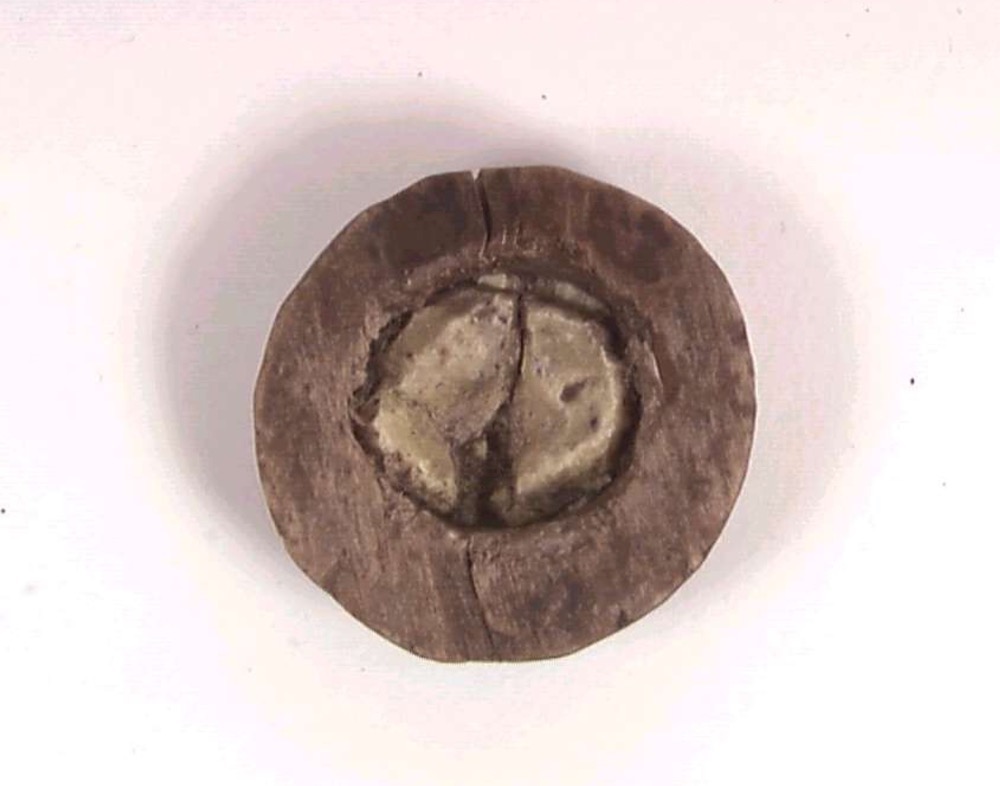
NSFA. 1728 Sulphur cup with lighter
This small sulphur cup is carved from wood and contains sulphur and tinder, and it is a fine example of a tool made out of necessity. The tinder was kept in its own pouch., dollabursa, together with fire steel and a small piece of flint. The matchbox's dimensions are 3 cm in diameter and 1.2 cm in height. It was received by the university's ethnographic museum from Oamasvuotna / Storfjord in 1931.
Sulphur box with tinder. Photo: Norwegian Museum of Cultural History.
NFSA. 3130 Hunting belt with equipment
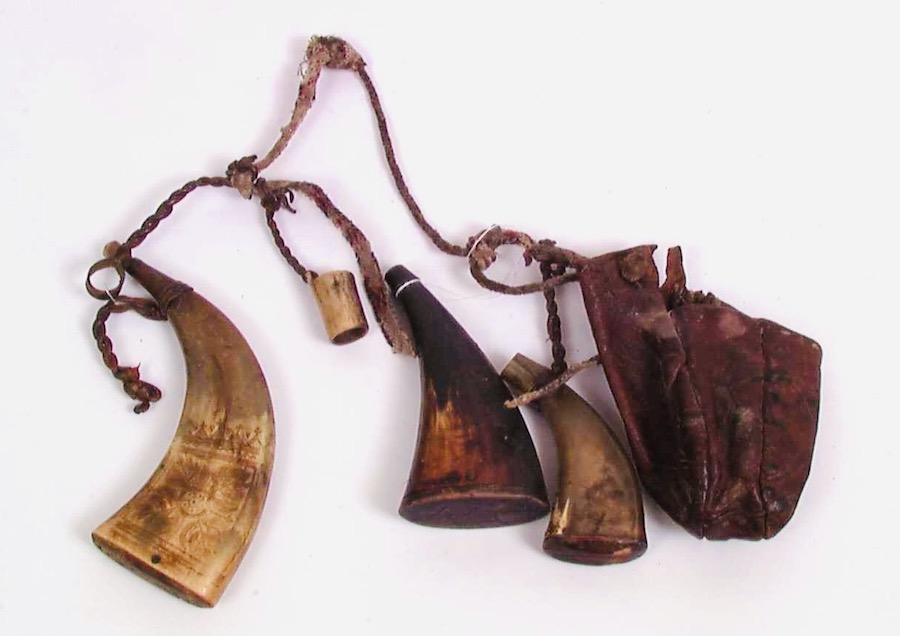
The bivouac accessories/hunting belt with equipment consists of 3 horns, a small bone container and a leather pouch attached by leather straps to a woven band. One of the horns is ornamented, and inscribed in the hunting equipment are the inscriptions: a)IONACD c)ON.
Hunting belt with equipment. Photo: Norwegian Museum of Cultural History
The hunting equipment was used in Moskavuotna/Ullsfjorden (Sørfjorden), Ivgu/Lyngen. It was acquired by the Norwegian Folk Museum in 1952. According to linguist Konrad Nielsen's descriptions of hunting equipment in Lappish Dictionary. Systematic Part., The hunting equipment consisted of: «powder horn, flintlock, bullet pouch which also contained wadding for cleaning the rifle, two powder measures made of reindeer horn (the small one for birds, the large one + the small one for bears), in the middle a powder measure for birds, with a pin to regulate the amount of powder». (Nielsen 1979: 392 (170).
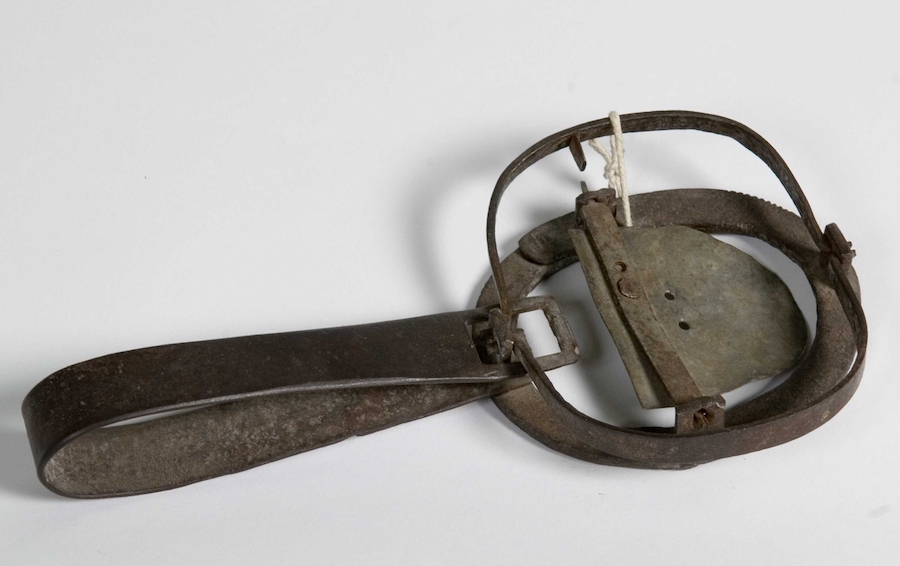
NFSA. 2546 Buoiddaruovdi / røyskattsaks
The stoat trap is forged and riveted, and consists of a spring steel construction with bows that snap shut on contact with a base plate. Height 8 cm, width 10.2 cm and length 25.5 cm. Ole Thommasen (1999:80) describes that larger animals such as bear, wolf, wolverine, fox, and otter were also caught in similar traps. Skins from large and small animals were of great importance in the fur trade. The stoat trap was collected by Dr. Asbjørn Nesheim in Biertávárri/Birtavarre, Gáivuotna/Kåfjord, in 1949. It was received by the University Ethnographic Museum in 1949. Nesheim was employed as the administrator for the newly established Sámi department at the Norwegian Folk Museum in 1951.
Roller/weasel trap, folded. Photo: Norwegian Museum of Cultural History.
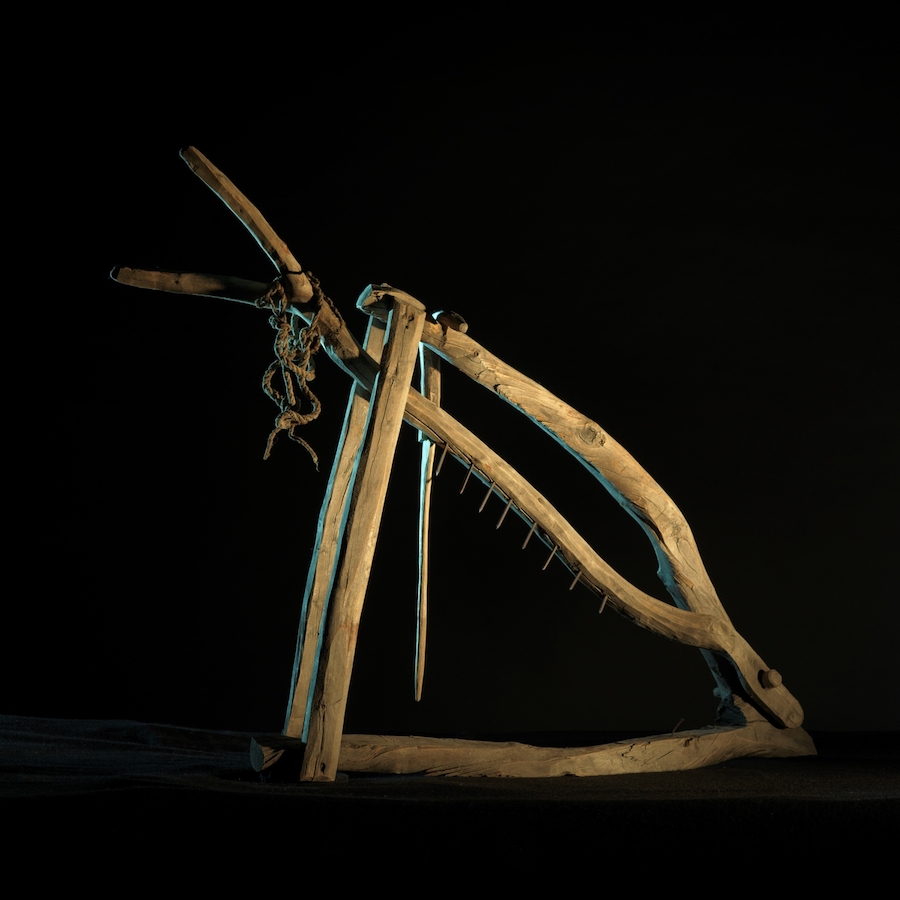
NFSA. 1416 Otter-stick, Outer fell
Triangular otter trap, made of wood with a twisted rope and iron rivets, featuring a separate section for bait attachment. Length 115 cm, height 75 cm, and thickness 14 cm. The bait attachment measures 36.5 cm in length. The otter trap originates from Bassevuovdi/Helligskogen, Oamasvuotna/Storfjord. It was acquired by the University Ethnographic Museum in 1912 by deacon Bertrand M. Nilsen.
Otter skin / otter pelt laid open. Photo: Norwegian Museum of Cultural History.
Schoolteacher Ole Thomassen describes the use of the čeavrastohkka / otter trap in Lyngen Parish in his notes from 1896-98:
otters are also caught with the so-called trap – chevelled a type of trap placed in the entrance of the hole, where the otter spends its days and consists of two approximately metre-long birch logs, fastened together at one end with a hinge. The inner side of both logs is fitted with approximately 5 cm long iron spikes. One of these, the base log, is secured firmly with stones across the opening of the hole, whereas the other, the top log, is balanced at one end with a stone weight placed there, so that when the otter begins to force its way into the hole, the log falls down and the otter is squeezed between them.
Thommassen 1999. The Sami's Relationship 80-81
Spiritual culture
Among people who have always lived in close contact with nature, their spiritual beliefs are strongly influenced by this. In the Sami worldview, nature was filled with powers and forces that humans had to relate to. Physical and spiritual contact with nature was necessary for survival; it was in nature that they found their bearings.
Spiritual culture is rooted in our regional landscapes and the conditions of life that have shaped worldviews, beliefs, and philosophies, which are still with us today. Objects that are returned are bearers of elements from ancient Sámi nature religion, customs, and traditions. Healing traditions are important elements in this, something a cupping horn illustrates.
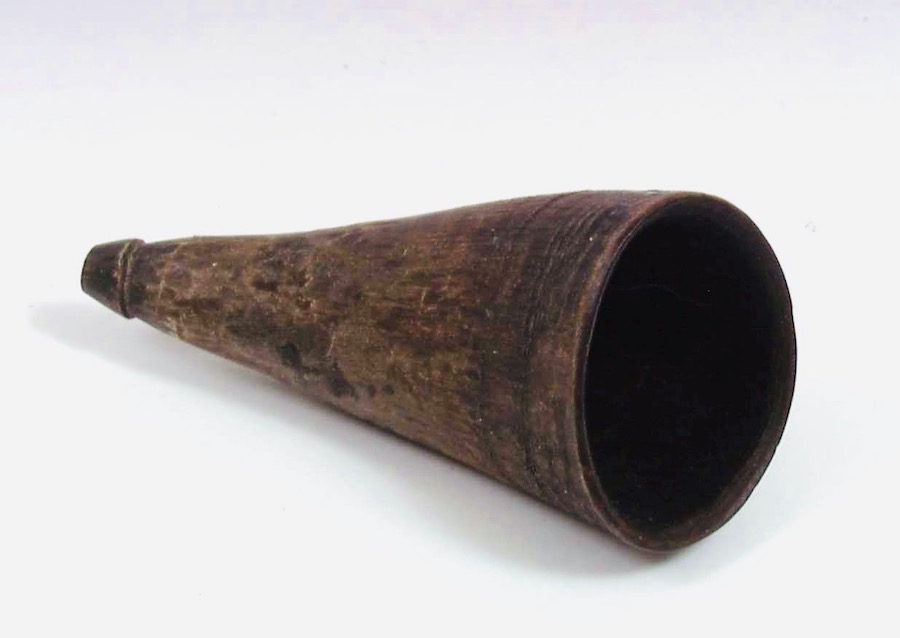
NFSA. 3129 GuhppenSami CoffeeoRight now.
Guhppenčoarvi / Spoon-horn. Photo: Norwegian Museum of Cultural History.
NFSA. 3129 Guhppenčoarvi / Drinking horn made of horn and elaborately decorated with a carved mouthpiece, and is ornamented with stripes at the top. Length 10.5 cm and top width is 5 cm. The item was used in Njoaski / Njosken, Moskavuotna / Ullsfjord. It was produced by Ole F. Nilsen, Sørstraumen, and was acquired by the Norwegian Folk Museum in 1952.
Cupping was used for healing / curing. Cupping as a method of healing is described by Ole Tommassen in The Sami's relationship «Cupping is used in such cases when pain gathers more in a specific place in the body, and was used where the pain was located, for example, in headaches, back pain, chest pain, arm pain, and at times with eye and ear inflammations« (1999: 116).
NFSA. 0139 Divination belt
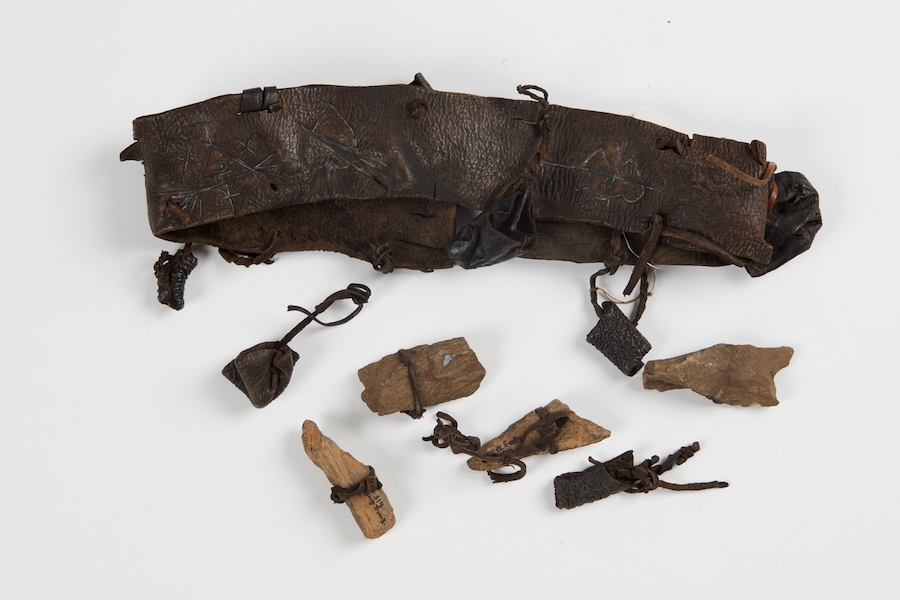
The 'einnostanávvi', or fortune-telling belt, is an item we consider to be very unique. It is linked to the ancient Sami nature religion. From our region, this is a rare, distinctive, and valuable item, and it is wonderful that it is being returned to the area where it belongs.
The Einnostanávvi / divination belt is a wide leather belt with attached leather cords bearing leather pouches and stones (rocks/gems/jet) with fossil imprints. It is approximately 54.5 cm long and 5.4 cm wide. The belt is ornamented with symbolic figures engraved into the leather: hearts pierced with lines, an all-seeing eye in a triangle with crosses on the sides, and lines of varying lengths. A total of four stones and eight small leather pouches, or pieces thereof, were attached to the belt. The Einnostanávvi / divination belt is from Bassevuovdi / Helligskogen, Oamasvuotna / Storfjord. The divination belt dates from approximately 1750 and was acquired by the University's Ethnographic Collections in 1903.
Einnostanávvi/ divination belt. Photo: Norwegian Folk Museum.
This ancestral/prophecy belt is referred to as Women's beltof Leather and ring in older museum protocols. It has been described as used for healing and for seeing into the future. Yngvar Nielsen, historian and director of the Ethnographic Museum, 1877-1916, has described the einnostanávvi/prophecy belt: »Through consultation with QUIGSTAD, it has later been clarified that the practice of taking omens about future events by looking through a woman's belt was indeed known to the Lapps, even if rarely mentioned. Thus, it is likely that a very valuable artifact has been acquired here that sheds light on old Lappish superstition.» (Nielsen 1907: 94f.).
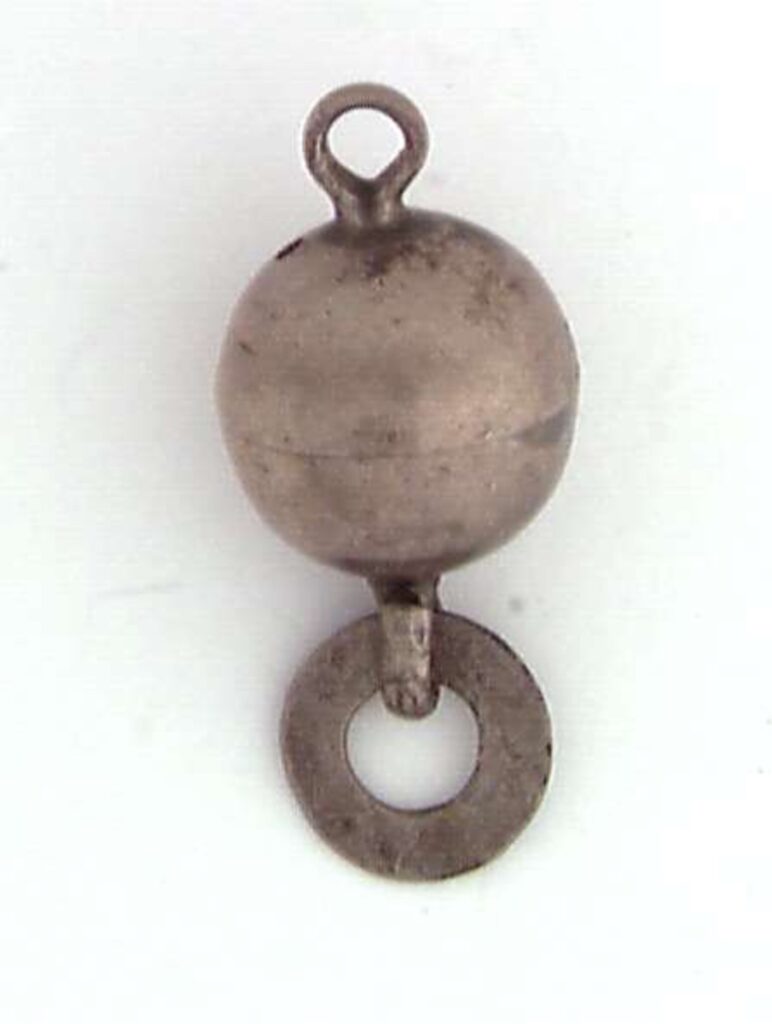
NFSA. 1579 Šiella/ silver ball, silver handle
NFSA. 1579 Šiella/silver ball, silver spindle is made of silver and has ring fastenings at both ends as well as a flat ring on the lower fastening. The ball's length is 3.4 cm and diameter 1.3 cm. The šiella/silver ball was collected in Sálašvággi/Tromsdalen, Romssa/Tromsø, and sold to the University Ethnographic Museum in 1918 by missionary Lars Larsen. Šiella/silver balls have been described as protective and lucky charms, and as 'komse' balls. (The term njiehceboallu is also used for such 'komse' balls. Reference: Duodjeinstituhtta, Kautokeino. Káren E. Gaup, 22.5.2017).
Slippers/ silver ball, silver spoon. Photo: Norsk Folkemuseum.
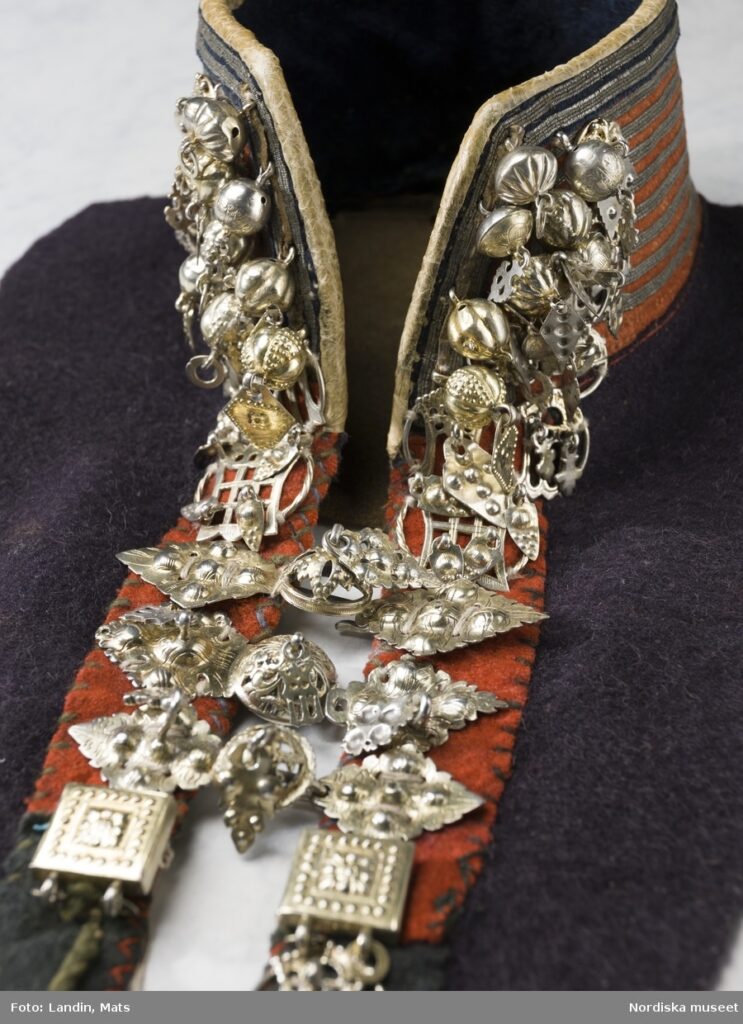
Silver balls, silver studs were also used as decoration on silbarahka/ silver collars. Ole Thommassen describes silbarahka/ silver collars in Lyngen: «In the same way, a garment is embellished (with crow silver), which was only worn around the neck by women, and whose edges reached a little way down the chest, shoulders, neck and back, though not so far down that armholes were needed. It was only used for special occasions and was made of dark blue cloth with strong fur on the inside... It was fastened at the front with small round silver studs, which served as buttons. It was most often edged with silver-plated braid and along the edge, as well as around the neckline, the aforementioned silver studs were also attached. Its name was silbarahka». (Thomassen 1999: 40).
Silver collar from the Nordiska Museet collections: «Silver collar. Used in Senjen, Tromsö, Norway at the beginning of the 19th century». Photo: Mats Landin. Nordiska Museet, Stockholm.
On this silver bracelet/collar, stated to be from Senja in Troms, one can see the same type of šiella/silver bead, a silver stud attached to the rising collar.
Copy
The Centre for Northern Peoples will receive copies of two objects from the Bååstede project.
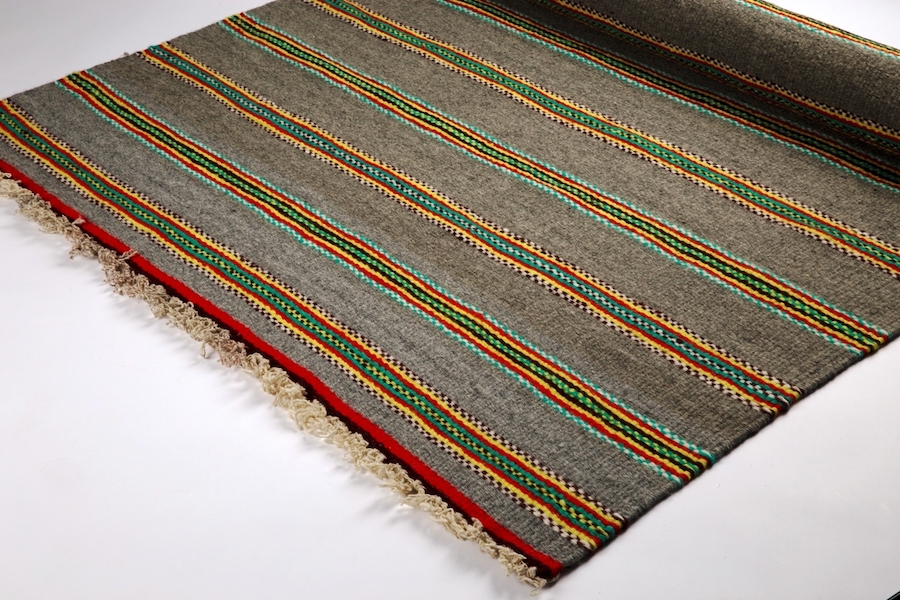
NFSA. 3655 Rats/green
This knitted/woven patterned band with colourful stripes was produced by Nils Oppervoll, Olmmáivággi/Manndalen, Gáivuotna/Kåfjord, 1958. The band is in natural and dyed colours.
Hand-spun yarn, with a grey base and two alternating patterned stripes in the colours black, white, red, yellow and turquoise. It has a red trim, wider stripes at the top and bottom. Length 2.10m and width 1.40m.
Rátnu / grene. Photo: Norsk Folkemuseum.
This branch with colour stripes shows a traditional use of colours. In the 1920s, it became possible to obtain dye in powder form – purchase dyes – for dyeing yarn and fabric. They came in bags and were meant to be boiled with a certain amount of water, soda, and salt. Hearvaránut branches with several clear colours in the stripes were common until the 1950s.
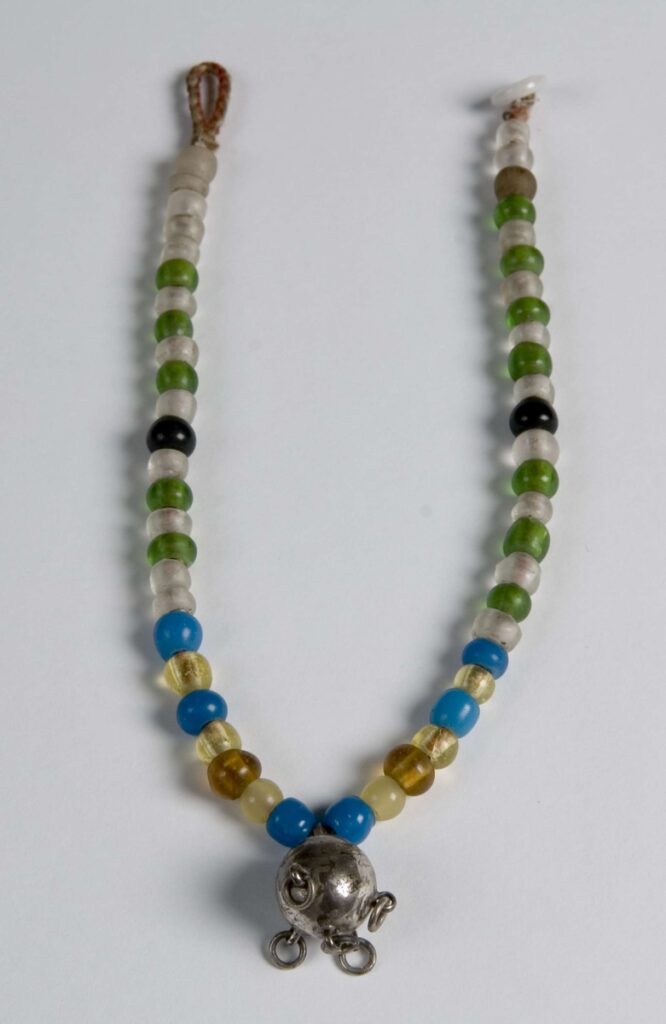
NFSA. 1570 Pearl necklace with silver bead
The beaded necklace with silver ball is made of colourful glass beads threaded onto string. Necklace length: 37 cm, bead diameter is 0.9 cm. In the centre of the beaded necklace, there is a silver ball threaded on with 5 small rings. This type of silver ball is also known as a "komse" ball, a protective and lucky amulet.
NFSA. 1570 was collected in the Sálašvággi / Tromsdalen area, Romssa / Tromsø by missionary Lars Larsen, and sold to the University Ethnographic Museum in 1918.
Pearl necklace with silver bead. Photo: Norwegian Museum of Cultural History.
The object refers to the connection between spiritual and material culture. Such chains were used for protection, for example, by hanging them on a child's cradle.