
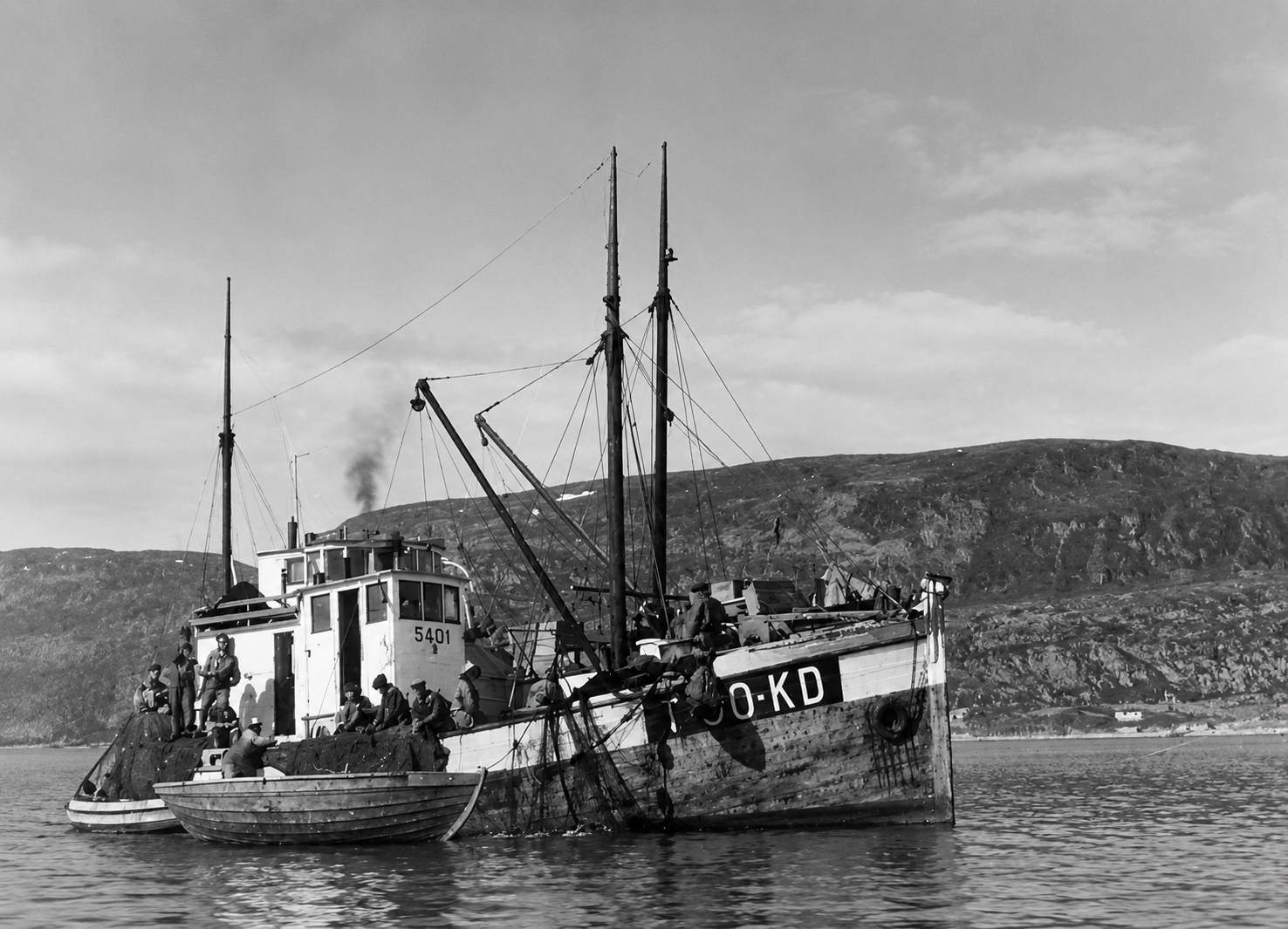

Thorvald Joramo recounts the time he was on board ”Saga” and was fired upon on two occasions.
As told to Nils-Ole Dalvik
-I was 18 years old that year, and had been travelling for about two years with Erik Dalvik on ”Saga”. The others who were with us were Peder Nilsen, Harald Steinlien, Harald Hansen (Seljeskog), Eilif Larsen, Arthur Soleng, and a fellow from Langnes. These were the regular crew on ”Saga”.
The attack in the early summer
- The first time we were attacked was when we were on our way into Hammerfest in the early summer. A plane came in from the sea and shot at us without hitting us. The Germans on land nearby returned fire, but they didn't hit the plane. Why the plane shot at us I don't know, but we had often heard of fishing boats being fired upon. The planes usually came in from the sea, presumably from aircraft carriers further out.
When the oil tanker at Rypefjordneset was attacked by English planes, we were ashore in Hammerfest. The Germans wanted us in the air-raid shelters, but we preferred to watch the attack and the fire, and did not go to the shelter as we had been told.
The attack outside Latøya
It became really serious when we were attacked off Latøya in the autumn of ”44 while we were hauling a purse seine. Then a small fighter plane came, it was probably an English plane – we could see round markings under the wings. Had the plane come five minutes earlier, the skipper would hardly have survived the attack. He was standing in the wheelhouse at the time while we were pursing the net. The wheelhouse was peppered with bullets, and the door was shot in such a way that it was almost cut in two. Fortunately, he had come on deck himself to help pull in the net. We had only hauled in a tiny bit of the net when we saw the plane coming in towards us. I stood watching the plane myself and noticed that he was beginning to aim at us. Then I opened the companionway door, and the moment I saw the lights flashing on the front of the plane, I dived in through the companionway door. The fellow from Langnes did the same, but before he could get to cover, he was hit in one ear and lost his earlobe. When he came down into the cabin, I had lain down in the bottom bunk. He grabbed me and asked, ”Are you dead?”. I didn't answer at first, but he shook me hard again and asked, ”Are you dead?”. ”No,” I said, ”I'm not dead.” Then he jumped into the same bunk too, he didn't fancy lying in the same bunk as a corpse. (Ahead of time we had talked about exactly such attack scenarios, and we thought it best to lie down lowest down in the boat, and in shelter behind the net if it was in the process of being hauled. We thought the bullets would hardly go through the net which was being pursed.) Then Artur Soleng also came down. ”Not everyone has survived this time, because someone was screaming so on deck," he said. Harald Hansen had also come down into the cabin. He had been hit in both lower legs, but despite that he was able to stand on his feet.
Crew and boat damaged
As soon as the plane stopped firing, I jumped up onto the deck. I wasn't scared, nor did I really think that much about it either. One of the crew shouted, ”we're sinking!”. He came up from the engine room, and he looked a sight, covered in oil. The oil tanks had been shot and leaked, and it turned out that it was oil filling up the engine room, and not water as they first thought. But the boat had also taken several bullet holes below the waterline. Harald also heard the shouts on deck, and he too thought that someone had been shot and killed. He also wanted to get up on deck despite being injured, but as he was on his way up the stairs, he fainted and fell right down into the cabin. Then he broke his left leg almost completely off. He got a nasty open fracture and bled a lot. We managed to lift him up from the cabin and placed him on top of the cargo hatch. We bandaged him to stop the bleeding. Then we started signalling to another boat, ”Duen” of Talvik, which was nearby. It didn't come at first, but then I was sent up the mast to signal from there. Then ”Duen” came to help. As soon as I was down on deck, Erik asked me to get Arthur up from the cabin. ”He needs to come up and make a stretcher for Harald,” he said. We laid Harald on the stretcher that was made, and transferred him over to ”Duen”, which took him and Eilif Larsen into Hammerfest. Eilif Larsen had been shot in the arm, but the bullet luckily passed between both bones in the arm. Karen from Langnes stayed on board; his ear injury wasn't so bad that he had to go to hospital.
Saved the boat and the saithe
-There was still a lot of saithe in the net, about 25 tonnes as it turned out. The question was whether we should let it go or not. But there was no question of us opening the net. We hauled in the saithe, and shifted the saithe more to one side of the boat so that the bullet holes on the other side were above the waterline. That way we managed to save the cargo of saithe, and that helped to save the boat. But the oil tank was leaking, so we had to use ”Siri” as an oil tank. (”Siri” was a 10-litre tin bucket, often used as a toilet on board.) In it we filled oil from a reserve drum we had on deck which was undamaged. We delivered the catch in Snefjord. When we had delivered the catch, we youngsters wanted to carry on fishing, as there was plenty of saithe everywhere. But skipper Erik didn't want to. ”Now we've had enough, we're going home,” he said. So we headed for home.
Injured for life
Harald Hansen spent around five months at Hammerfest Hospital after the shooting drama. From there he was evacuated by the boat ”Vefsn” to Harstad, and afterwards to Hognfjorden in Vesterålen. The injuries had marked him for the rest of his life. His widow, Gerda (92), recounts that he would sometimes pick out bone fragments from one of his lower legs, as they would somehow emerge from time to time. He also went through several operations.
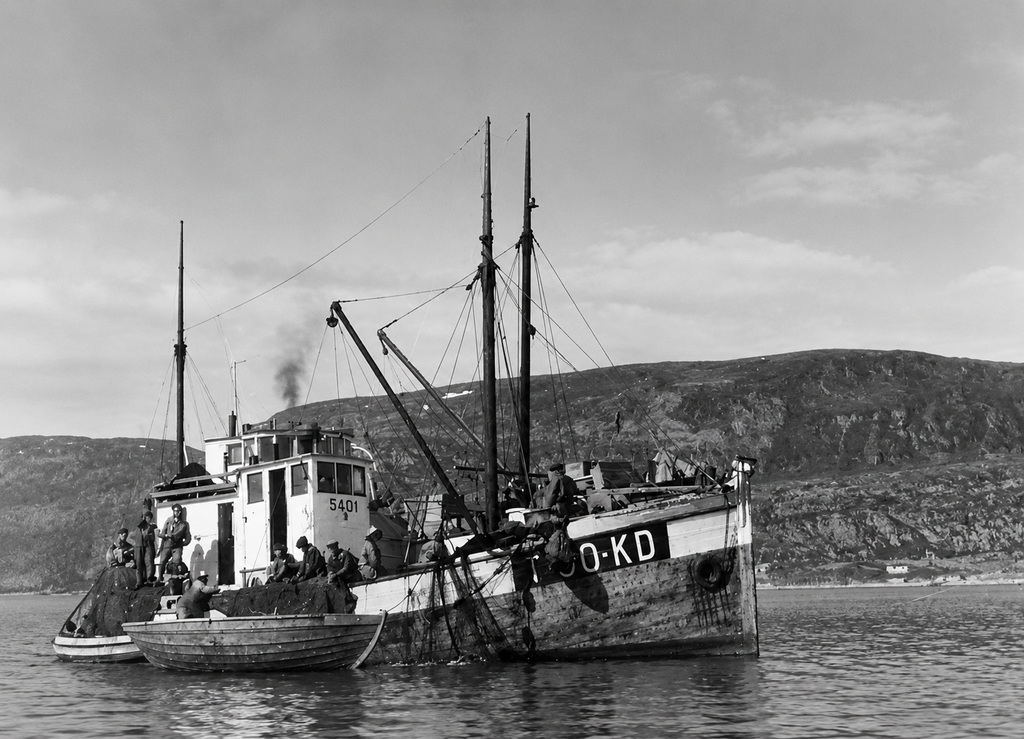
Photo: Nils Solvang, enhanced using AI